Get Full Government Meeting Transcripts, Videos, & Alerts Forever!
Get email alerts on the Land Use Data Centers topic
No spam. Unsubscribe anytime.
Spotsylvania adopts interim data‑center standards: 1,000‑foot setback and 75‑foot height cap
Summary
After hours of public comment and staff testimony, the Spotsylvania County Board of Supervisors adopted interim data‑center development standards including a 1,000‑foot setback from sensitive uses, a 75‑foot building height limit, preservation of mature buffers or 8‑foot berms, and prohibitions on groundwater cooling.
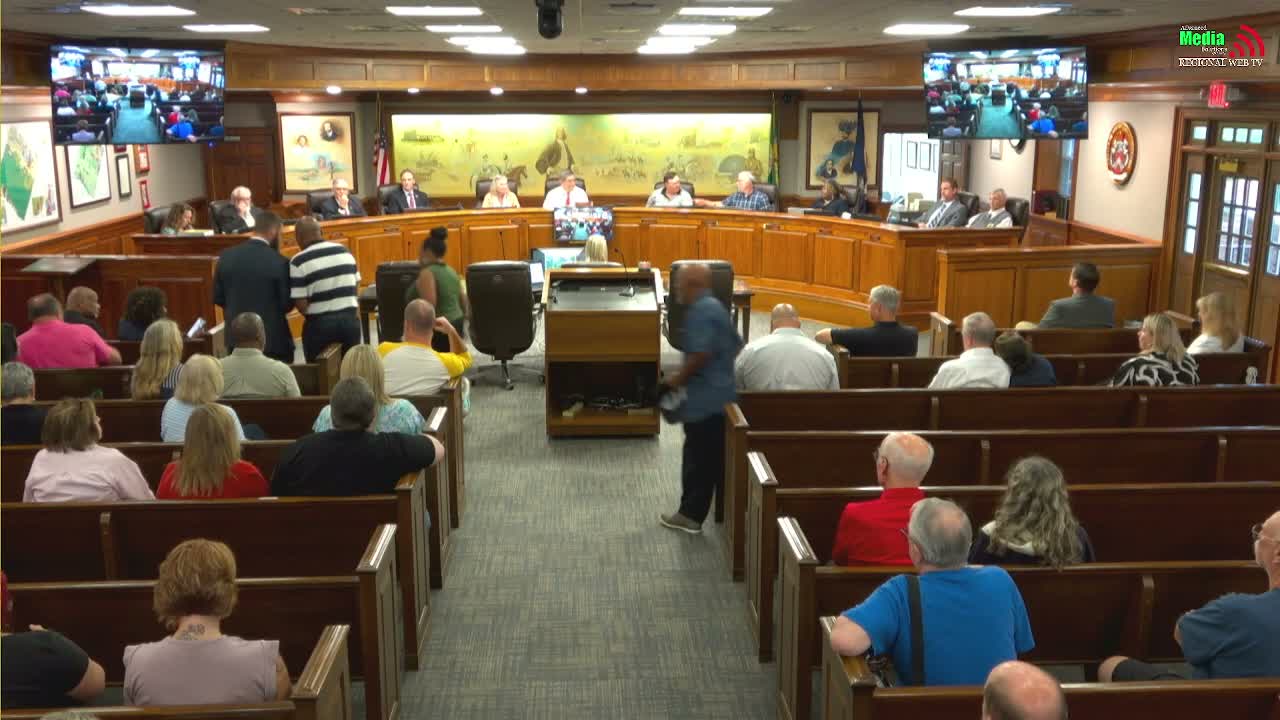
The Spotsylvania County Board of Supervisors voted Aug. 12 to adopt interim development standards for data centers, responding to weeks of public concern about noise, water and power use, and neighborhood impacts.
The board approved a 1,000‑foot setback requirement measured from the adjacent property line of residences, parks, places of worship, schools, day‑care facilities and hospitals to any data‑center structure, and a 75‑foot maximum building height in industrial zoning where data centers are permitted. Both measures passed unanimously.
Planning staff presented the county’s inventory of approved and pending data‑center projects and the planning commission’s draft standards before the vote. "We estimated approximately 2,000 acres by‑right that could be developed as data center, though much of that acreage is constrained," Kimberly, county planning staff, told the board while outlining options to keep data centers as a permitted use in industrial districts with clear development standards.
The ordinance changes adopt several of the planning commission’s recommendations: a minimum 100‑foot landscaped or preserved vegetation buffer from property lines (with a rule that no data‑center structure be closer than 300 feet to a residential dwelling as a baseline), a 50‑foot roadway frontage buffer, requirement of preserved mature forested vegetation or an 8‑foot landscaped earthen berm for screening, and a view‑shed analysis for projects within 1,500 feet of historic overlay districts or nationally registered historic sites. Staff also recommended that mechanical equipment and generators be screened and that only Tier‑4 (or equivalent/better) generators be used, with generators enclosed in sound‑dampening barriers.
Several speakers at public comment urged stronger protections or a site‑by‑site special‑use permit (SUP) requirement. "We're asking the board to slow down and take a breath," a resident, Carden Wyckoff, said, invoking Loudoun and other Northern Virginia examples. Other residents raised concerns about stormwater runoff, clear‑cutting, noise and long‑term property values. Staff responded that the draft language would prohibit groundwater use for industrial cooling and that rain‑harvesting for industrial cooling would be added to the prohibited list.
Board members debated two broad approaches: requiring SUPs for all data centers so each site would be reviewed individually, or establishing countywide standards that apply to by‑right industrial uses. A motion to require SUPs failed on a 3‑4 vote. After deliberation, the board adopted the standards by majority consensus on the specifics presented: the 1,000‑foot setback (measured to any data‑center structure) and the 75‑foot height cap passed 7‑0.
Supervisors asked staff to refine the ordinance language to clarify how setbacks interact with property topography and to tighten definitions (for example, specifying which residential types are covered). County planning staff said they will return with final ordinance language, additional details about stormwater and wetlands mitigation options, and suggested thresholds for landscaping and fenestration on facades visible from public roads or residences.
The board also asked staff to follow up with the county’s fire and EMS leadership on response capacity at potential data‑center sites and to ask Dominion Energy and Rappahannock Electric Cooperative for briefings on possible effects to the grid and on rate structures. Planning staff said state regulations govern fuel‑storage thresholds for generators and that those thresholds trigger state permitting and spill‑prevention requirements.
The planning changes set a new baseline for developers and will apply to by‑right industrial parcels; projects that cannot meet the standards would have to seek a special use permit and come before the board for additional review. The board set the next procedural steps for staff to draft ordinance language and schedule public hearings.