Get Full Government Meeting Transcripts, Videos, & Alerts Forever!
Get email alerts on the Deed Fraud topic
No spam. Unsubscribe anytime.
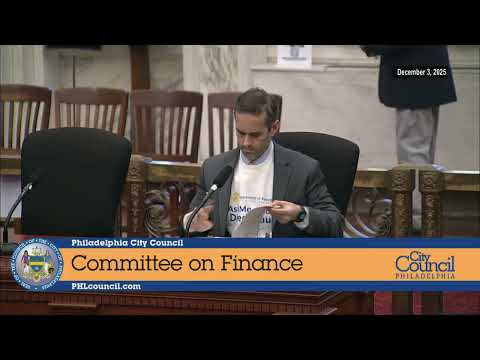
Council committee advances ordinance to let deed-fraud victims reclaim realty transfer taxes
Summary
The Finance Committee reported bill 250,574 to let homeowners who win quiet-title actions seek refunds of realty transfer taxes paid by fraudsters; City records and Community Legal Services said refunds will be modest in fiscal impact but meaningful for victims, and staff agreed to produce an interdepartmental process map.
Councilmembers on the Philadelphia City Council’s Committee on Finance reported favorably on an ordinance (bill 250,574) that would let homeowners who obtain a court order voiding a fraudulent deed petition the city for a refund of realty transfer taxes paid by the fraudster.
James Leonard, commissioner of the Department of Records, told the committee the change corrects an ‘‘inequity’’ in current practice because the city retains transfer-tax revenue paid by scammers even when courts later restore title to the rightful owner. Leonard said the bill "allows a victim who obtains a court order voiding a fraudulent deed to petition for a refund of the realty transfer taxes paid," and described safeguards: a certified court order directing a refund and a three-year filing window.
Kate Dugan, divisional supervising attorney for the property tax team at Community Legal Services, urged approval and cited rising reports of deed fraud. She said the Office of the Recorder of Deeds received 132 reports of deed fraud in 2023 and noted that where fraudsters paid transfer taxes, victims currently lack a clear path to recover those funds. Dugan said the bill shifts the determination of entitlement to the courts rather than the Department of Revenue or the Tax Review Board.
A member of the public, Vince Gilliam, described a six-year ordeal in which his family’s home was taken through falsified paperwork; he told the committee the direct costs to his family were ‘‘probably in excess of…$4,000 to $5,000’’ and said a cash refund would ‘‘absolutely’’ help his family.
Council members pressed for a broader accountability strategy identifying where in the recordation and title process fraud occurs, asking whether title insurers, notaries or lenders can be held liable. CLS said prosecutors sometimes pursue fraud rings but bad actors often use false names or LLCs and leave town, making recovery difficult; the witness and members agreed the refund bill is one targeted relief measure within a larger enforcement and prevention effort. Commissioner Leonard agreed to produce an interdepartmental process chart showing checkpoints where the city can intervene.
The committee approved a motion to report the bill with a favorable recommendation and to request suspension of rules so it may receive first reading at the next Council session. The motion passed by voice vote.