Get Full Government Meeting Transcripts, Videos, & Alerts Forever!
Get email alerts on the Da Midyear Request Public Safety topic
No spam. Unsubscribe anytime.
District Attorney Krasner previews $2.6M midyear ask for drug‑ and gun‑crime enforcement and trafficking work
Summary
District Attorney Larry Krasner told the Appropriations Committee that his office will request about $2.6 million in Class 100 midyear funding for FY26 to expand staff for a Dangerous Drug Offender Division, strengthen the gun‑violence task force and create a targeted human‑trafficking unit; he and staff detailed how retail‑theft and diversion programs fit into the plan.
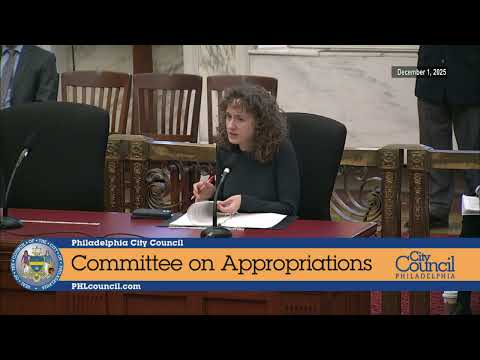
District Attorney Larry Krasner on Dec. 1 used his time before the Philadelphia City Council Appropriations Committee to preview a FY26 midyear payroll request of roughly $2.6 million intended to expand the DA’s office capacity for enforcement and prosecution.
"We will be requesting to about $2,600,000 in class 100 midyear appropriation in the general fund to fully fund payroll costs connected to ongoing and new public safety violent crime and modern enforcement related initiatives," Krasner said. He framed the request as support for hiring and retaining attorneys and staff for several city‑priority initiatives, including a planned expansion of the Dangerous Drug Offender Division (DDOD), bolstering the DA’s gun‑violence task force, and a human‑trafficking task force.
Krasner described DDOD as a hybrid model that can combine state‑court speed with federal‑style investigative tools — wiretaps, extended surveillance and technology — to target "professional drug dealers" and multi‑generational drug operations. "We could do 5 KIPP and Cambrias a year," he said, citing an earlier intensive investigation as an example of the unit’s potential impact.
On retail theft, Krasner said the DA’s retail‑theft task force has contributed to recent reductions and invited Kimberly Essek, supervisor of the Economic Crimes Division, to describe operations. Essek told the committee the task force is "fully prepared" for continued operations in 2026 but is constrained by staffing. She highlighted daily coordination with Philadelphia Police Department detectives, merchant outreach and an app for store reporting that she said has increased merchant engagement.
Committee members asked how Krasner’s payroll request would support diversionary programs such as AMP and wellness court. Krasner said he remains a strong supporter of AMP and that changes in Philadelphia Police Department pre‑arrest diversion efforts have changed referral patterns, but the DA’s office will continue to support rehabilitation and diversion where appropriate.
Krasner framed the request as part of a balanced, collaborative public‑safety strategy that includes prevention and community‑based anti‑violence work. He also noted the DA’s office funds some community violence prevention work through seized assets and other non‑city funding streams and emphasized partnership with federal, state and local law enforcement in prosecuting complex organized criminal activity.