Get Full Government Meeting Transcripts, Videos, & Alerts Forever!
Get email alerts on the Sanitation topic
No spam. Unsubscribe anytime.
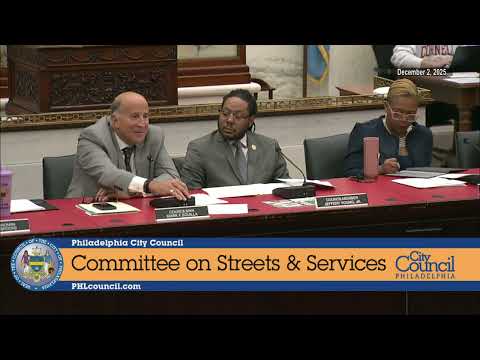
Committee hears testimony backing requirement to keep dumpsters locked to curb illegal dumping
Summary
Officials, a Center City advocacy group and haulers told the Streets & Services committee that requiring locked dumpster lids could reduce illegal dumping and litter; business and hauling witnesses urged pilots and operational clarity about keys, toters and service protocols.
The Philadelphia City Council Committee on Streets and Services heard testimony in support of Bill 250843, which would amend Chapter 10‑700 of the Philadelphia Code (refuse and littering) to require that licensed dumpsters remain locked except when in active use.
Crystal Jacob Shipman, commissioner of the Department of Sanitation, testified that the ordinance would require licensees to “keep dumpster lids locked except when in use or when the dumpster must be open to accommodate a trash chute,” and to maintain the area around dumpsters free of refuse or overflow. She told the committee the proposal is part of the administration’s clean-and-green agenda and cited enforcement activity and public contacts involving dumpsters: “In 2024, 3,877 code violation notices … and warnings were given for dumpster lids being left open and unsecured. In 2025, so far to date, 5,207 CVNs and 229 contacts and warnings have been given for dumpster lids being left open and unsecured.”
Andrew Jacobs, vice president of planning and public realm at Center City District, said the group surveyed 446 dumpsters in Center City and found the majority in violation of existing code. “Of the 446 dumpsters we surveyed within the study area, 68% were unlocked or unsealed, 41% had trash beneath or adjacent to them, and 77% lacked the required medallion or visible permit holder information,” Jacobs said, arguing locked containers would improve alley and sidewalk conditions and reduce visual disorder.
Haulers and business representatives generally supported the bill’s goals but urged caution on implementation. Dominic Fulginiti of Republic Services told the committee that a citywide mandate raises operational questions: who installs and maintains locks, who provides access, and how to manage thousands of different container types. “We have about 5,000 customers, and that would mean about 10,000 carts,” Fulginiti said, urging a pilot program to test approaches before a broad requirement.
Committee members pressed witnesses on pragmatic issues. When Chair Young asked whether landlords would have to distribute keys for shared-use dumpsters, Deputy Commissioner Keith Warren replied that users and haulers would likely “have to provide keys to everyone” or rely on coded access systems like swipe badges. Witnesses and members discussed alternative container designs (underground or enclosed systems) and the potential for pilot areas to evaluate logistics.
Sanitation officials pointed viewers and residents to city convenience centers as an option for large or household loads and said information about drop‑off locations is posted on the city website. Several members emphasized the need for shared responsibility among property owners, business operators and haulers.
The Streets committee subsequently moved all agenda bills, including Bill 250843, to be reported from committee with a favorable recommendation and requested that council rules be suspended to permit first reading at the next council session; that motion was adopted by voice vote.
What’s next: The committee reported Bill 250843 to full council with a favorable recommendation; council will consider first reading at a forthcoming session.