Get Full Government Meeting Transcripts, Videos, & Alerts Forever!
Get email alerts on the Budget Year End Transfer topic
No spam. Unsubscribe anytime.
Council hears year-end transfer ordinance; budget director warns failure to pass could trigger technical bond default
Summary
Budget Director Sabrina Maynard told the Philadelphia Council Appropriations Committee Dec. 1 that the FY2025 year‑end transfer ordinance (Bill 251027) is routine but necessary to align appropriations with actual spending and to permit audited financial statements; she said not passing it would create a technical bond default. Committee members pressed for department-level detail on personnel overages and overtime drivers.
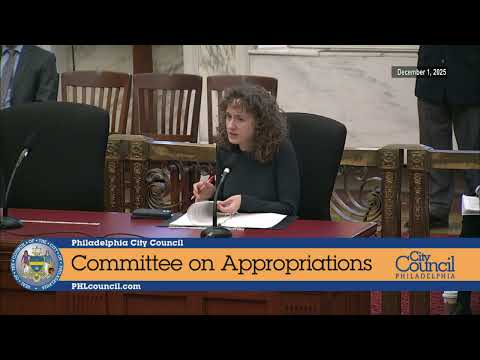
The Philadelphia City Council Appropriations Committee on Monday heard testimony on Bill 251027, the fiscal‑year 2025 year‑end transfer ordinance, with Budget Director Sabrina Maynard saying the measure is a routine but essential step to close the city’s books and allow audited financial statements.
"The annual year end ordinance is a routine ordinance that we transmit every year during the fall," Maynard told the committee. She said the ordinance moves appropriations within and between the general fund, water fund, water residual fund, grants revenue fund, aviation fund and transportation fund so final appropriations reflect what the city actually spent in FY25. When asked about timing, Maynard said the ordinance is a critical step in the process with the controller’s office and that failing to pass it "would be a technical default on our bonds."
Members of the committee pressed for detail about departments that exceeded Class 100 (personnel) budgets. Council member Bass asked how so many departments could be over budget on personnel. Maynard said the city has added staff since Mayor Parker took office — "about 1,600 general fund positions" — and that drivers of overruns also include higher‑than‑expected overtime in some public‑safety units. She cited last year’s parade, a plane crash and an "enhanced code blue" as events that increased overtime costs.
Other queries focused on a specific agency, OHS, which Maynard said netted roughly 27 full‑time equivalents and would use internal transfers from Classes 200, 300 and 400 to partially offset Class 100 increases. City Solicitor Renee Garcia explained that some law‑department payroll costs reflect staff embedded at the airport and water functions and confirmed the office’s code/enforcement team is fully staffed.
Maynard and committee members agreed to follow up with departmental backup documentation and detailed class‑by‑class breakdowns at the chairman’s request. No vote was taken on the ordinance at the Dec. 1 hearing; Chair Mark Scuilla recessed the proceeding to Thursday, Dec. 14 at 9 a.m.
The hearing transcript shows committee members requested written backing for underspend and transfer figures; those breakouts were not provided on the record and are noted in this report as "to be provided" by budget staff.