Get Full Government Meeting Transcripts, Videos, & Alerts Forever!
Get email alerts on the Mobile Medical Providers topic
No spam. Unsubscribe anytime.
Committee advances mobile medical-providers restriction despite broad public opposition
Summary
After extensive public comment warning that the ban would reduce access to HIV care and harm-reduction services, the committee reported bill 250720 favorably (with one recorded nay). Health department staff described a new permit process and said four applications have been submitted; public health advocates and providers urged the committee to delay or reject the ban.
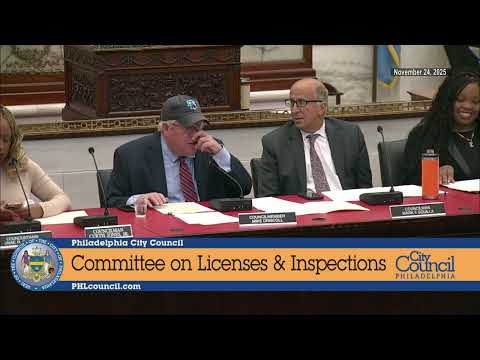
The Committee on Licenses and Inspections voted to report bill 250720 favorably and suspend council rules for first reading, despite lengthy public opposition from health advocates, nurses and residents who said the measure would curtail access to lifesaving services.
Ben Hartung, public policy adviser for the Philadelphia Department of Public Health, told the committee the department is accepting permit applications under a Board of Health regulation for mobile medical service providers and has received four applications so far — three for operation in the 7th Council District and one for the 3rd. Hartung described the permit application as collecting provider location, types of services and the supervising practitioner specialty, saying the aim is to improve coordination and continuity of care.
Public witnesses urged the committee to reject or delay the ban. Kelly Flannery, policy director at Positive Women’s Network, said the bill “will result in restricted access to life saving care, increased HIV transmissions, and preventable deaths,” arguing mobile units connect people who use drugs and people experiencing homelessness to services. Sam Pfeiffer, a community organizer with Positive Women’s Network, told the panel the permitting scheme “hasn’t even gone into enforcement yet” and said the ban would bar providers from entire wards; Pfeiffer added the ordinance proposes fines of up to $1,000 for organizations.
Nurse and researcher Crystal Greenberg summarized a literature review showing mobile addiction-medicine programs can achieve higher retention rates and documented examples of overdose rescues tied to naloxone distribution. Resident Leah Shepherd described seeing discarded needles and said the measure criminalizes people experiencing homelessness rather than addressing root causes such as housing shortages.
Committee members pressed officials on metrics and enforcement timelines. Hartung said metrics have not been finalized and that the department planned to work with data staff and community partners (for example, syringe cleanup counts) to monitor neighborhood impacts. Pfeiffer and other witnesses noted that enforcement was not scheduled to begin until Dec. 1 under the permitting timeline, and called for evaluating the citywide regulatory scheme before imposing district-specific bans.
Council member Scuilla moved to report bill 250720 with a favorable recommendation and to suspend council rules to permit first reading; Council member Gilmore Richardson seconded. The motion carried on the ayes with one recorded nay (the transcript notes “1 nay” for the record). The committee forwarded the bill to the full council where it will receive first reading under suspended rules.