Get Full Government Meeting Transcripts, Videos, & Alerts Forever!
Get email alerts on the School District Oversight topic
No spam. Unsubscribe anytime.
Mayor and school leaders tout gains and outline facilities and budget plans as charter nonrenewal dispute intensifies
Summary
At a Committee of the Whole oversight hearing, Mayor Cheryl Parker, Board President Reginald Streeter and Superintendent Tony Watlington highlighted improved test scores, expanded extended day/extended year programs, and a facilities master plan. Councilmembers pressed officials on charter nonrenewals, contract negotiations with school staff unions, the district’s fund balance and recent borrowing after a state budget impasse.
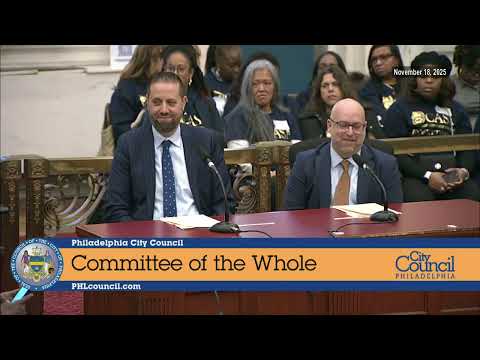
Philadelphia’s Committee of the Whole convened a public hearing on the School District of Philadelphia where Mayor Cheryl Parker, Board of Education President Reginald Streeter and Superintendent Tony Watlington presented progress metrics, program expansions and fiscal plans — and answered extended questioning about charter renewals, labor negotiations and facility use.
Mayor Cheryl Parker opened the hearing by endorsing the board and superintendent and pointing to measurable gains: rising test scores, improved attendance and lower dropout rates. She highlighted state budget support from Governor Josh Shapiro and the city’s legislative delegation, touted a 38.5% representation rate for teachers of color (the highest since 2001), and described a William Penn Foundation-funded debt‑free pathway to four‑year teaching degrees for 40 students at Community College of Philadelphia. Parker also described the administration’s extended day/extended year initiative — 40 schools launched so far, voluntary and free, now including individualized tutoring — and new partnerships for fresh produce distribution to schools.
Board President Reginald Streeter described the board’s goals and guardrails and noted measurable gains (notably increases in grade‑level math proficiency and college‑and‑career readiness). Vice President Sarah Ashley Andrews and board members summarized Project RISE, an effort led by the charter schools office with external consultants to revise the charter performance framework by spring 2026.
Superintendent Tony Watlington presented district data showing attendance and assessment gains, and he described the facilities master plan process: an eight‑phase effort with extensive community engagement (more than 47 listening sessions and 5,700 survey responses) and options to reinvest in underutilized buildings. Watlington said the district expects to bring facilities recommendations this winter after extra engagement.
Council members used the question period to press on several contentious issues. On labor, members asked why principals were participating in public advocacy rather than at school; Watlington said contract negotiations with Teamsters Local 502 (Casa) are ongoing and the administration is optimistic about a near‑term agreement but could not discuss bargaining specifics from the dais. On the budget, CFO Mike Herbstmann said the district’s fund balance was $749.5 million as of June 30 but that the district plans to use about 45% of it this fiscal year and must close a roughly $300 million structural deficit by fiscal 2029–30. Because of a state budget impasse, the board authorized up to $1.55 billion in tax anticipation notes and the district borrowed about $700 million through mid‑November; interest was estimated at roughly $15 million for the maximum authorization and will scale with actual borrowing.
The hearing also focused on charter‑authorizing practice. Several council members, charter operators and parent advocates urged the Board of Education to pause pending nonrenewal decisions and to follow the charter schools office recommendations, citing the Ballard Spahr review that described inconsistent or opaque authorizing practices. Board President Streeter said the board has for the first time expanded transparency on renewal deliberations and directed the board to explain its reasoning in public meetings; he also cautioned some matters are the subject of active litigation.
Deputy Superintendent Colonel Oz Hill described a new Facilitron reservation system for community use of school athletic fields and explained the current fee schedule (about $55 per hour) is intended to offset staffing and security costs; councilmembers asked staff to provide a breakdown of net district cost and to explore targeted subsidies for community groups.
Public comment included several charter CEOs and parents who asked council to exercise oversight and to pause nonrenewal actions to avoid destabilizing schools and neighborhoods, citing one‑year renewals and conditional renewals that they say have reduced staffing stability and community trust.
What’s next: council members requested multiple follow‑ups in writing on charter demographics, vendor lists for extended day tutoring, the vendor/community mapping for partnerships, CTE credentialing enrollment and the final facilities recommendations; the chair noted a dedicated facilities hearing is scheduled for January.