Get Full Government Meeting Transcripts, Videos, & Alerts Forever!
Get email alerts on the Waste Management topic
No spam. Unsubscribe anytime.
Environment committee advances bill to bar Philadelphia contracts with waste-to-energy incinerators
Summary
The Philadelphia City Council Committee on the Environment voted to report Bill 250,768 — the Stop Trashing Our Air Act — recommending that the full council consider a ban on contracts that send city solid waste to waste‑to‑energy/incineration facilities. The move follows extensive testimony from Chester and Delaware County officials, public-health experts, residents and industry representatives; the administration said it supports an objective study in the city’s pending RFP.
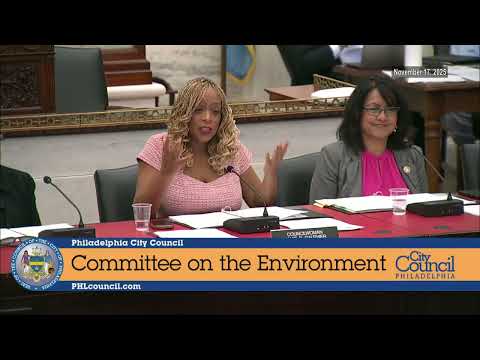
Philadelphia’s City Council Committee on the Environment voted to send Bill 250,768 — known as the Stop Trashing Our Air Act — to the full council with a favorable recommendation after a daylong hearing that featured testimony from Chester and Delaware County officials, public‑health experts, community residents and representatives of ReWorld (formerly Covanta).
The motion, made by Vice Chair Cindy Bass and seconded during the committee meeting, passed by voice vote. The committee also requested that the rules of council be suspended to permit first reading of the bill at the next session.
The bill would amend Title 17 of the Philadelphia Code to bar contractors providing municipal solid‑waste, recycling or composting services to the city from incinerating discarded matter under specified terms. Chair (Gautier) and supporters described it as an environmental‑justice measure, saying the Chester waste‑to‑energy plant is a regional pollution hotspot that has long harmed residents’ health.
Why it matters
Mayor Stefan Roots of Chester, whose city hosts the ReWorld facility, told the committee the plant occupies roughly 50 acres of waterfront and that “we are burning trash from New York, Philadelphia, and beyond.” Roots said the incinerator has contributed to high local rates of asthma and infant mortality and urged Philadelphia to stop sending trash to Chester and pass the bill.
Dr. Kristen Motley, Chester’s health commissioner, described local health burdens she said are linked to the facility: “Chester’s infant mortality rate is five times the national average,” she testified, and pediatric asthma rates are “four times the national average.” She told council members that studies commissioned by industry that downplay health effects are insufficient and urged policy action.
Delaware County’s sustainability officer, Rebecca Jurkovich, summarized a county‑commissioned life‑cycle analysis that compared incineration followed by ash landfilling with direct landfilling. Jurkovich said the study found the incineration‑first pathway was 2.3 times more harmful overall for the environment, climate and health, and that isolating human‑health effects (excluding broader climate impacts) showed much larger differences — the county’s testimony described that figure as about 23 times worse for localized human‑health impacts.
Administration position and procurement questions
Carlton Williams, director of Clean and Green Initiatives, and Sanitation Commissioner Crystal Jacobs Shipman told the committee the city currently disposes roughly 60 percent of municipal waste by landfill and about 40 percent via waste‑to‑energy, and that Philadelphia’s sanitation and procurement obligations require a fair, open and competitive RFP process under Pennsylvania Act 101.
Commissioner Shipman said the city’s municipal waste contract budget is roughly $52.7 million for solid waste and $10 million for recycling; she cautioned that eliminating one disposal option could raise costs and operational burdens, estimating a possible 12 percent increase in disposal costs (an administration witness later described that estimate as roughly $6.5 million per year). The administration asked the committee to hold the bill until results of the city’s objective RFP analysis are available but said it would incorporate environmental criteria into the procurement evaluation.
Industry testimony and monitoring questions
ReWorld environmental manager Kim Bradford and AECOM’s Brian Stormwind defended the Chester facility, saying the plant’s monitored emissions are within permit limits and presenting an AECOM multi‑pathway health‑risk assessment based on EPA modeling that — under conservative assumptions — found concentrations below EPA cancer and noncancer thresholds. ReWorld also described upgrades that it says cut NOx and mercury emissions and said it makes continuous monitoring publicly available.
Council members raised recent DEP/EPA notices of violation at the Chester plant — including incidents tied to monitoring downtime and an instance involving a truck with radioactive medical waste — and pressed ReWorld on inspection rates and corrective actions. ReWorld acknowledged notices on record, described self‑reporting and corrective steps, and said daily inspections cover roughly 5–10 percent of loads plus additional floor surveillance.
Public comment and community testimony
Dozens of Chester residents, local health professionals and environmental advocates urged passage of the bill, citing high local cancer and asthma rates, community testimony of odors and truck traffic, and long‑standing concerns about environmental racism. Witnesses from Delaware County and community groups reiterated their support and asked Philadelphia to stop sending trash to Chester when the city’s contracts expire.
Several labor and business witnesses and ReWorld employees emphasized the facility’s local jobs and community programs and urged caution on immediate contract changes without operational transition plans. Multiple speakers — including administration officials and some council members — said the city should pair any policy change with investments in diversion, recycling and worker transition funding.
What happened procedurally
After questioning and public comment, Vice Chair Bass moved that the committee report Bill 250,768 with a favorable recommendation and that council rules be suspended to permit first reading at the next council session. The motion passed by voice vote; the committee recorded the bill as reported favorably and the hearing was adjourned to allow extended public comment. The full council will receive the bill for first reading as requested.
Next steps
The city’s procurement office has said it will include objective environmental impact analysis in the fall RFP for municipal waste contracts and that any new contract would be scheduled to begin July 1, 2026. The committee’s favorable report sends Bill 250,768 to the full City Council, where members will consider first reading and subsequent votes.
Quotes
“We don’t want it. Burning trash in Chester is an impediment to our economic and community development,” Mayor Stefan Roots said, urging the council to act. “Stop trashing our air.”
“Chester’s infant mortality rate is five times the national average,” Dr. Kristen Motley told the committee, describing local health impacts she said are tied to decades of industrial pollution.
“We request the bill be held in committee until the RFP is completed and more data is available,” Sanitation Commissioner Crystal Jacobs Shipman said, emphasizing Act 101 procurement requirements while also saying sanitation would include environmental criteria in the RFP process.
Methodology and sourcing
This article summarizes testimony and exchanges presented at the Committee on the Environment public hearing on Bill 250,768. Direct quotes and specific numeric claims are attributed to speakers who made them during the hearing. The text does not add or infer facts beyond what witnesses and officials stated on the record.
Ending
The committee’s favorable report moves the Stop Trashing Our Air Act to the next council session for first reading; council members and the administration said the city will continue the RFP process that could inform final contract decisions and any implementation timeline.