Get Full Government Meeting Transcripts, Videos, & Alerts Forever!
Get email alerts on the Water Conservation topic
No spam. Unsubscribe anytime.
Commission recommends water-conservation element for Herriman City general plan
Summary
Planning staff and consultants presented a water-conservation element required by state code; the commission unanimously recommended it to city council after discussion about data sources, outreach and local implementation measures such as rebates, smart controllers and customer dashboards.
The Herriman Planning Commission unanimously recommended that the City Council adopt a new water-conservation element to the Herriman general plan, a requirement under recent state code updates.
City staff introduced the element and said it compiles local context, regional targets and implementation strategies. A consultant summarized the element's structure and objectives: understand the effect of development on demand, operate city facilities to support water-efficient practices, and implement policy strategies in categories such as community character, education and engagement, incentives and recognition, leading by example, regulations and standards, monitoring and collaboration.
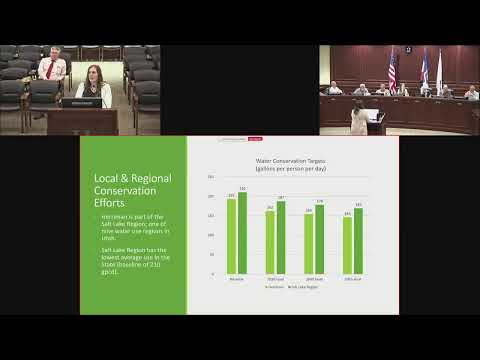
The consultant cited Herriman's current water profile: per-capita use around 152 gallons per day (2023 data), roughly 15,000 culinary water connections and a mix of supplies (five wells, springs, secondary irrigation and Jordan Valley delivering about 75% of the city's supply). The element also links to regional conservation goals from a 2015 baseline through 2065 and identifies opportunities for city-led programs (rain sensors in parks, rebates, outreach and customer dashboards).
Commissioners had questions about outreach, Jordan Valley partnership opportunities, smart-controller rebates and data sources; staff and consultant pointed to existing Jordan Valley and city resources, on-line design guides and customer portal dashboards that can alert residents to high use. Following discussion a commissioner moved to recommend approval of item 5.2 to the City Council; the motion was seconded and passed unanimously.
The commission noted the element will be forwarded to City Council (the next council meeting was noted as Oct. 22) and highlighted that the element aims to reduce per-capita demand through policy, program and development-pattern changes.