Get Full Government Meeting Transcripts, Videos, & Alerts Forever!
Get email alerts on the Winter Driving Safety topic
No spam. Unsubscribe anytime.
Mike Stagg urges drivers to prepare vehicles, slow down as storms arrive
Summary
In a virtual winter-driving briefing for Utah drivers, presenter Mike Stagg urged vehicle checks — batteries, tires, wipers and washer fluid — and building an emergency kit, stressing repeatedly to 'drive to the conditions' and slow down to reduce crash risk.
Mike Stagg, speaking in a virtual winter-driving safety briefing, told drivers to check key vehicle systems, pack an emergency kit and slow down as storms approach. "As the temperature drops below 32 degrees, your battery is going to lose about 33% of its cold cranking efficiency," he said, advising replacement of batteries older than roughly four to five years.
Stagg said three priorities should guide winter travel: know your limits, take your time and prepare both vehicle and self. He urged drivers who are uncomfortable in snow to consider delaying travel or working remotely when possible and emphasized that slowing down on icy roads is the most important safety step.
On maintenance, Stagg recommended checking battery terminals for corrosion and tight connections, inspecting tire tread and choosing tires marked with the three-peak mountain snowflake or "M+S" (mud and snow). "A 3 mountain snow peak...identifies that tire as a good all season tire," he said, adding that fleets should select tires bearing that mark when swapping is not practical.
Stagg described winter-specific wipers and washer fluids: winter blades have a full rubber cover and perform better in snow and ice; for washer fluid he recommended deicer/antifreeze formulations (he noted orange-labeled all-season and yellow-labeled winter fluids). He also urged verifying engine-coolant and defroster operation and returning ice scrapers and brushes to vehicles before travel.
For emergency readiness, Stagg advised adding weight to rear axles on rear-wheel-drive vehicles, keeping the gas tank at least half full, and carrying jumper cables, a phone charger compatible with the device, a collapsible shovel and an auto emergency kit containing a reflective hazard triangle, retroreflective vest, warm outerwear, water and high-energy food.
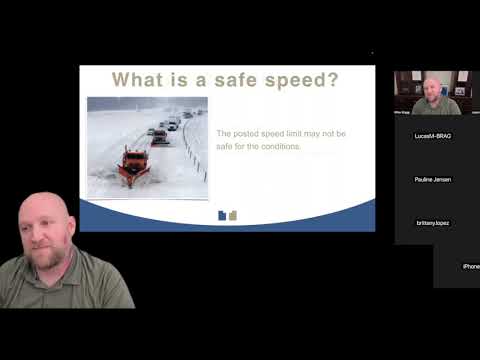
On visibility and on-road technique, Stagg told drivers to clear ice and snow from all windows, mirrors, the hood and the roof so snow does not obstruct the driver's view or blow onto vehicles behind. "It's just a good citizen thing," he said of clearing the top of a car. He warned that posted speed limits may not be safe in storms and advised motorists to "drive to the conditions," use low beams in falling snow and carry sunglasses for glare on bright, sunny snow days.
Stagg offered specific guidance for regaining control when traction is lost: for understeer he said to keep the wheels turning, brake gently and steer toward the intended path; for oversteer the correction depends on drivetrain — in rear-wheel-drive vehicles take your foot off the gas, in front- or all-wheel-drive apply light throttle and "steer into the skid." For fishtailing he recommended keeping wheels turning, applying light throttle in front/all-wheel-drive vehicles and pointing the wheels down the road to regain traction.
If stranded or in a crash, he advised staying in the vehicle when it is the safest place and calling 911. The briefing closed with a reminder to perform these checks before travel and to "slow down and do things right," as the storm approached.