Get Full Government Meeting Transcripts, Videos, & Alerts Forever!
Get email alerts on the Sidewalk Safety topic
No spam. Unsubscribe anytime.
Utah Government Trust webinar: cities urged to inventory, inspect and document sidewalks to cut trip-and-fall risk
Summary
In a Utah Government Trust webinar, presenters told municipal and county staff that local governments generally own and must maintain sidewalks, urged frequent inspections and written inventories, recommended prioritizing high-risk locations, and highlighted legal risks and funding options including UDOT matching funds.
In a webinar hosted by the Utah Government Trust, presenters told municipal and county staff that local governments typically own sidewalks adjacent to state and local roadways and carry a nondelegable duty to maintain them. Jason, the primary presenter, said jurisdictions should inventory sidewalks, inspect frequently, mark hazards and document repairs to reduce trip-and-fall exposure and preserve legal defenses.
Why it matters: trip-and-fall claims are rising and can defeat governmental immunity when an injury is caused by a defective or dangerous public improvement, presenters said. Jason warned that failing to act after notice can erode defenses: he cited a 2013 Salt Lake City case in which the court concluded the city had not acted quickly enough after becoming aware of an unsafe condition.
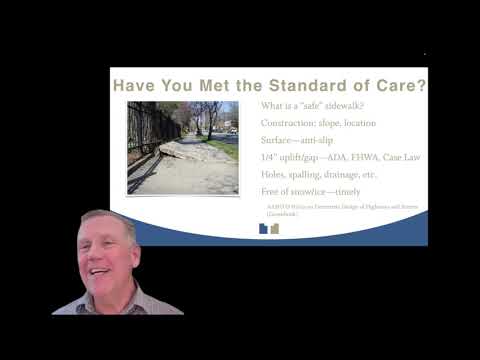
Presenters laid out operational thresholds and priorities. Jason cited the Americans with Disabilities Act’s quarter-inch threshold as a widely used benchmark for trip hazards and recommended treating uplifts above 2 inches as extreme and urgent. Crack-width thresholds discussed included quarter inch to a half inch as low-to-moderate priority, half inch to 1 inch as high, and larger gaps or missing panels as extreme. For spalling, losing roughly 25–50% of a panel was described as an extreme risk that should be addressed promptly.
On ownership and state roads: Jason said state code generally places maintenance responsibility for park strips, sidewalks and pedestrian ramps on the local government even when a state highway runs through a jurisdiction, though UDOT may do replacement work as part of road projects. Jeff added that pedestrian ways on UDOT-built bridges are an exception — UDOT typically maintains bridge pedestrian ways — and recommended documenting and notifying UDOT when the public is using a curb or gutter as an informal walkway.
Inspection and documentation requirements: presenters noted a statutory duty for local agencies to inspect frequently or designate a competent person to identify unsafe conditions and to take appropriate action. Jason emphasized the practical effect: keep a current inventory, log inspections and repair actions in a work-order or complaint-resolution system, and visibly mark hazards (safety yellow was recommended) if immediate repair is not feasible. "If it isn't written down, it never happened," Jason said, underscoring documentation as a primary defense in claims.
Funding and cost-sharing: presenters discussed options for financing repairs, including resident cost-sharing programs (50/50 splits or parts-and-labor arrangements) and enforcement tools (fines, liens) where allowed by ordinance. Jason noted UDOT’s 'safe sidewalks' program can provide matching funds (presenters cited a 25% match) when jurisdictions meet program requirements. Presenters also recommended budgeting a contingency reserve to respond quickly to high-profile claims.
Legal protection and process: speakers recommended that elected officials be part of prioritization decisions and that jurisdictions document deliberations to preserve discretionary-immunity protections. Jeff urged an annual presentation of developed data and a clear record of policy choices to strengthen legal defenses.
Quotes and perspectives: Jason summarized the session’s practical thrust: "Document, document, document." Jeff warned that the risk landscape is changing: "We're getting more law firms, and you're starting to see billboards and other advertisements addressing trip and fall hazards, not just auto accidents." Mike and Jason clarified ADA coverage during Q&A: paved municipal trails generally fall under the ADA; non-paved trails require analysis of undue burden and, if constructed with federal money, may need to remain open and cleared per federal transportation guidance.
What’s next: the Trust said it will distribute slides, sample sidewalk programs (Springville and Salt Lake City were mentioned as useful examples), and the webinar recording. Presenters encouraged jurisdictions to review ordinances for enforcement authority, assemble inventories, prioritize extreme and high-risk sections, and involve governing bodies in budget decisions.
No formal votes or policy adoptions were made during the webinar; presenters offered technical and legal resources and invited follow-up by email or through the Trust’s legal hotline.