Get Full Government Meeting Transcripts, Videos, & Alerts Forever!
Get email alerts on the Debate Recap topic
No spam. Unsubscribe anytime.
Republican candidates in Utah's 3rd District spar over debt, abortion, energy and Ukraine at debate
Summary
At a Utah Debate Commission forum in Salt Lake City, five Republican primary candidates debated federal spending and the national debt, abortion policy after Dobbs, housing affordability, U.S. support for Ukraine and energy priorities. Candidates split mostly between state-led versus federal approaches and emphasized transparency and oversight.
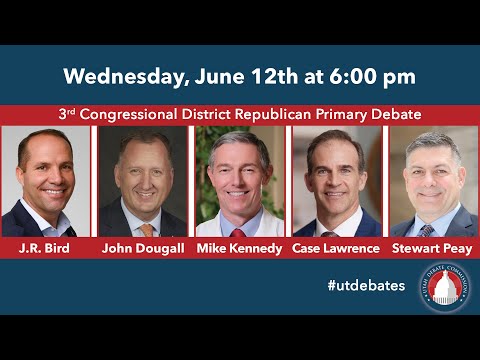
At a debate hosted by the Utah Debate Commission at the University of Utah, five Republican primary candidates for Utah's 3rd Congressional District framed contrasting approaches to fiscal policy, reproductive rights, energy and foreign affairs.
Moderator Thomas Wright opened the event and named the candidates: JR Bird, John Dougal, Mike Kennedy, Case Lawrence and Stewart Pay. The forum centered repeatedly on federal spending and the national debt, which several candidates described as an urgent national security and economic threat.
"The national debt is one of the greatest security threats we have facing our nation," John Dougal said, adding that Congress needs better budgeting and oversight to stop what he called "out of control spending." Case Lawrence echoed the need for "regular order" in the budget process and said entitlement reform was required. Mike Kennedy said he would vote no on omnibus bills he had not read and called Medicare and Medicaid "primary drivers" of waste he would target while preserving care.
Candidates diverged on the proper role of federal policy on abortion after the Supreme Court's Dobbs decision. Kennedy, Lawrence, Pei and Byrd described themselves as "pro-life" and largely favored states handling regulation; Lawrence said a 15-week federal ban could be considered if interstate "abortion tourism" continued, while others emphasized state-level solutions.
Housing affordability drew competing diagnoses. Lawrence attributed price rises to broad inflation and higher materials costs; Pei highlighted constrained land supply on the Wasatch Front and urged returning some federal land to state control to add supply. Several candidates raised immigration and regulatory barriers as contributors to rising costs.
On foreign policy, candidates generally supported aiding Ukraine with weapons and ammunition while expressing differing thresholds for continued support. Pei, Dougal and Lawrence said the U.S. should continue assistance; JR Bird urged stronger sanctions and energy measures to undercut Russia's revenue before endorsing unfettered aid and said he preferred "sending bullets, not boys." Several candidates warned against boots-on-the-ground interventions and said maintaining NATO commitments remained important.
Energy, including new nuclear projects and the role of coal in local economies, was a recurring theme. Candidates endorsed an "all-of-the-above" energy approach but emphasized different priorities: several promoted nuclear development and use of local uranium deposits; others stressed energy dominance, deregulation and support for coal as a baseline for base-load power.
Transparency and accountability surfaced across topics. When asked about repeated Pentagon audit failures, Dougal pressed for stronger congressional oversight, and Kennedy suggested investigations and funding consequences for noncompliance. Candidates supported financial disclosure for members of Congress when asked in a rapid round of questions.
Residency and local ties were raised during closing exchanges, with Stewart Pay stressing local roots and endorsements, and other candidates reaffirming their records and priorities.
The debate concluded with closing remarks and a reminder that the primary election is Tuesday, June 25. The Utah Debate Commission said the program was produced with facilities donated by PBS Utah.