Get Full Government Meeting Transcripts, Videos, & Alerts Forever!
Get email alerts on the Congressional Debate Ut 1 topic
No spam. Unsubscribe anytime.
Moore, Campbell and Cottam spar over immigration, housing and spending at USU debate
Summary
Incumbent Rep. Blake Moore and challengers Bill Campbell and Daniel Cottam debated foreign policy, immigration, housing affordability, youth mental health and fiscal policy at a Utah Debate Commission forum at Utah State University in Logan ahead of the Nov. 5 election.
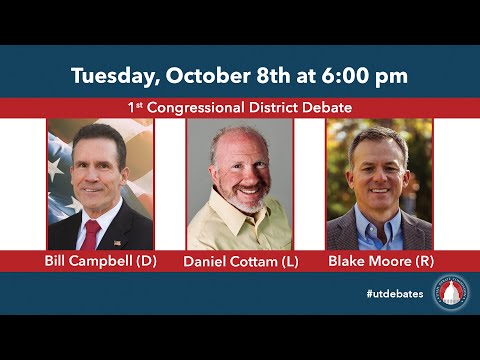
LOGAN, Utah — Three candidates seeking Utah’s 1st Congressional District seat clashed Tuesday evening in a Utah Debate Commission forum at Utah State University, debating immigration, foreign policy, housing affordability, youth mental health and federal spending in front of a campus audience.
Incumbent Rep. Blake Moore, who said he is nearing the end of his second term in Congress, framed his re-election bid around fiscal restraint and support for allies abroad. “In President Biden’s first two years of office…he enacted 5,000,000,000,000 net new dollars of government spending,” Moore said, blaming that spending for inflation and arguing Republicans have checked further expansion.
Bill Campbell emphasized his business and chief financial experience and repeatedly framed his campaign as “preferencing you, not special interests.” “My mission is to make the next four years good for you,” Campbell said, proposing market‑oriented responses to housing and AI while warning against using federal public lands for development.
Daniel Cottam, a practicing surgeon who identified as a Libertarian candidate, argued for smaller government, more worker visas and direct market solutions. “We should not let the perfect be the enemy of the good,” he told the panel on immigration, later adding that both major parties have failed to restrain spending and that voters should consider third‑party options.
On immigration, the candidates diverged over tactics and priorities. Moore said any successful package must include border‑security measures such as a return to remain‑in‑Mexico, an end to catch‑and‑release and changes to parole authority; Cottam stressed more work visas and a more open door for skilled workers; Campbell urged improving imperfect bipartisan bills and focusing on assimilation and oversight once newcomers arrive.
Housing near Hill Air Force Base and workforce training were central local concerns. Moore touted a bill to repeal an “180‑day rule” that he said impedes transitions from active duty to civilian employment and pointed to ideas modeled on enhanced‑use leases at military installations. Campbell proposed sending funds directly to qualifying individuals and incentivizing builders, saying families face an unfair market competing against large institutional buyers.
A student question about youth mental health drew different emphases: Campbell urged parity of mental and physical health coverage and inclusion within existing federal programs, Cottam argued the federal government is not the primary actor and called for state and community solutions, and Moore stressed awareness, stigma reduction and targeted federal support through agencies such as Medicare and CMS.
On governance and fiscal policy, Moore described legislation he introduced — the Comprehensive Congressional Budget Act — to make the full budget subject to annual votes and reduce the growth of mandatory spending. Cottam said the two‑party system is broken and urged new voices to force changes; Campbell called for civility and unity across partisan lines.
All three candidates said they have confidence in Utah’s local election processes and would accept the 2024 results. The debate closed with short final remarks and a reminder from the moderator that Election Day is Nov. 5 and that the Utah Debate Commission posts debates online.
The debate included questions from Utah State University students and lasted roughly the hour-and-a-half scheduled by the commission; no formal votes or motions were taken during the event. Additional materials and a recording of the forum are posted at utahdebatecommission.org.