Get Full Government Meeting Transcripts, Videos, & Alerts Forever!
Get email alerts on the Debate Overview topic
No spam. Unsubscribe anytime.
Cox, King and Latham clash on housing, energy and constitutional amendments at Salt Lake debate
Summary
Incumbent Spencer Cox, Democrat Brian King and Libertarian Rob Latham sparred over housing, energy policy, and two proposed constitutional amendments at a Utah Debate Commission forum at Salt Lake Community College, with sharp exchanges on Amendment D and competing plans for starter homes and renewables.
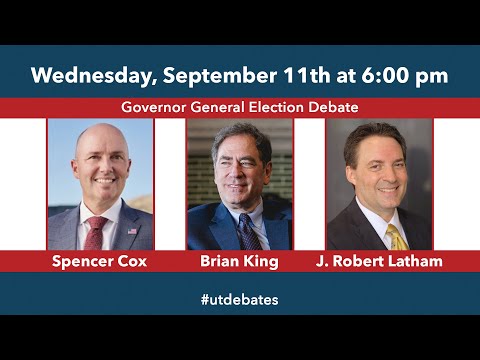
Moderator Jason Perry opened the Utah Debate Commission forum at Salt Lake Community College and introduced the three candidates on stage: Governor Spencer Cox, Representative Brian King and J. Robert (Rob) Latham. The hourlong event covered polarization, economic growth, energy, transportation, housing, and two ballot measures on the Nov. 5 ballot.
Cox framed the stakes as the continuation of a conservative record, citing his administration's accomplishments and pledging to build 35,000 starter homes over five years and to "double energy production" in the coming term. King described his campaign as focused on everyday Utahns, promising a governor who will "do hard things" for working families and criticizing what he called inconsistent positions on national endorsements. Latham positioned himself as an agent of systemic change, advocating proportional representation and market‑oriented reforms.
A central flashpoint was Amendment D, which would change how the legislature can alter citizen initiatives. King called it "a power grab" and urged voters to reject it; Latham said he would vote no. Cox defended allowing voters to decide and noted the governor does not directly control constitutional amendments. Education funding (Amendment A) also divided candidates: King warned that decoupling income tax revenues from guaranteed school funding would risk stability, while Cox and Latham supported options that would expand fiscal flexibility, with Cox noting a proposal to remove the state sales tax on food.
On housing, Cox emphasized construction targets and regulatory changes to spur density; King proposed disincentives for out‑of‑state speculative buyers and measures to prioritize Utah families. Energy arguments included King's call to accelerate renewables, Latham's endorsement of an "all‑of‑the‑above" mix that can include nuclear, and Cox's focus on permitting and federal barriers to projects.
The debate included student questions on ballot amendments and artificial intelligence. Cox described an AI policy lab convened by his administration; King stressed privacy and protections for children; Latham argued against heavy government control of AI. The candidates delivered short closing statements and reminded viewers about Election Day on Nov. 5.
The forum did not produce formal actions or votes; it served as a policy and character comparison for voters ahead of the general election.