Get Full Government Meeting Transcripts, Videos, & Alerts Forever!
Get email alerts on the Us Senate Debate topic
No spam. Unsubscribe anytime.
Utah Senate debate at Weber State spotlights public lands, climate and immigration ahead of Nov. 5
Summary
At a Utah Debate Commission forum in Ogden, candidates Carlton Bowen, John Curtis and Caroline Gleick clashed over public lands, climate policy, immigration and abortion, offering contrasting plans for water, housing and judicial confirmations ahead of the Nov. 5 election.
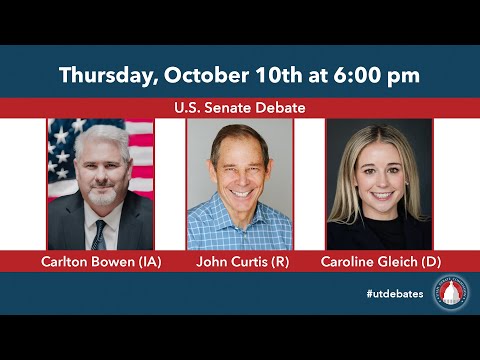
Glenn Mills, moderator for the Utah Debate Commission, opened the US Senate debate at Weber State University in Ogden and introduced the three candidates on stage: Carlton Bowen, John Curtis and Caroline Gleick.
The candidates diverged sharply on public lands. John Curtis pointed to the Emery County Public Lands Act as a model for using congressional legislation to reconcile grazing, recreation, extraction and protection, saying that "the only way you get that through congressional legislation is if you actually have consensus between the environmental groups, between ranchers, between off-road enthusiasts." Caroline Gleick argued federal protections are essential, warned that state transfers often lead to privatization and urged federal funding for land stewardship. Carlton Bowen said he would seek to rewrite the Antiquities Act and criticized large monument designations such as Bears Ears, calling some presidential monument actions "done without congressional input."
Water and the health of the Great Salt Lake featured prominently. Gleick said the lake is at a record low and warned of dust and public-health risks, noting in the debate that "71% of the water diverted from the Great Salt Lake is going to agriculture." Curtis emphasized working with agriculture and private-sector innovation, proposing incentives and competitions to develop conservation solutions. Bowen cautioned against changing the legal doctrine of "beneficial use," saying altering the definition could be risky for farmers and water users.
On climate and energy, Gleick framed the issue as urgent and tied it to public health and jobs, calling for accelerated clean-energy transition and saying she would end fossil-fuel subsidies. Curtis described his work with a conservative climate caucus and cited bipartisan steps such as support for geothermal and nuclear; Bowen criticized what he described as "climate agenda" overreach and framed his approach around free-market principles.
Immigration drew disagreement over enforcement and legal pathways. Bowen emphasized enforcing existing laws and opposed any measure he characterized as amnesty. Curtis defended a bipartisan bill he described as the "Dignity Act," explaining a multi-year, conditional pathway with fines, reporting requirements and English-proficiency tests. Gleick backed increased border agents, technology to intercept fentanyl and a vetted legal pathway for immigrants, and she opposed family-separation policies.
The candidates also debated judicial confirmation standards and court reform. Curtis said the primary test for nominees is fidelity to the Constitution and character; Gleick supported a binding ethics code for Supreme Court justices and 18-year term limits; Bowen opposed term limits absent a constitutional amendment and favored thorough Senate vetting.
Abortion and reproductive-health policy drew differing approaches. Curtis said he is "absolutely pro-life" but prefers decisions to be handled by states; Gleick described harms since Dobbs, raised concerns about IVF and maternal-health impacts, and framed reproductive decisions as private and best made by families and doctors; Bowen said he is "100% opposed to abortion" and described fetal-development milestones when arguing his position.
Throughout the night candidates traded rebuttals on party labels and records. Bowen repeatedly emphasized that Curtis had previously worked within the Democratic Party and framed himself as the only clearly pro-Trump option on the stage; Curtis pressed his legislative record and argued that governing requires building coalitions across parties.
Students from Weber State asked about youth engagement, and candidates proposed outreach and structural changes: Bowen encouraged outreach via digital platforms, Curtis emphasized meeting younger voters where they are and using social media, and Gleick proposed universal voter registration at driver's-license issuance, universal vote-by-mail and making Election Day a national holiday.
The debate closed with one-minute statements: Curtis emphasized stewardship and service if elected; Gleick called for generational change on housing, air quality and reproductive access; Bowen urged voters to choose his pro-Trump, constitution-centered platform. Moderator Mills reminded the audience to vote on Nov. 5 and to contact county clerks with voting questions.
Reporting note: the transcript supplied includes inconsistent spellings for one candidate'9s last name (appearing as "Glake," "Gleick," and "Blake"); this article uses "Caroline Gleick," which matches the majority of references in the record and the candidate'9s self-description as a small business owner and policy advocate. Several numerical claims made on stage (for example, national-debt characterizations and certain public-health statistics) are reported here as stated by candidates and not independently verified in this account.
The Utah primary and general-election calendar remains in effect; voters were reminded during the debate that Election Day is Tuesday, Nov. 5.