Get Full Government Meeting Transcripts, Videos, & Alerts Forever!
Get email alerts on the Debate Roundup topic
No spam. Unsubscribe anytime.
Utah attorney general candidates emphasize independence, transparency at Southern Utah University debate
Summary
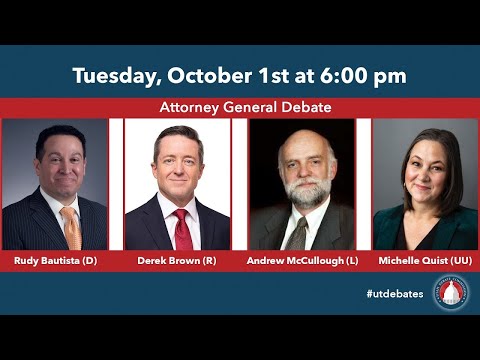
At a Utah Debate Commission forum in Cedar City, four candidates for attorney general — Michelle Quist, Rudy Bautista, Derek Brown and Andrew McCullough — highlighted independence from partisan influence and pledged greater transparency, including making AG calendars public.
CEDAR CITY — Four candidates for Utah attorney general met at Southern Utah University on a debate stage hosted by the Utah Debate Commission, where they pressed competing visions for the office but agreed on one immediate pledge: to make the attorney general’s calendar public.
Moderator Mara Carabello opened the event and explained the format. Michelle Quist, who received the first response in a prior random drawing, framed her campaign as an effort to return integrity to an office she called “politicized” by “corruption, scandals, and self dealing.” “Politics do not belong in law enforcement,” Quist said.
Rudy Bautista described himself as a 25-year defense attorney and Navy veteran who has refused campaign contributions to avoid donor influence. “We need someone in the attorney general’s office who understands that the job is…to protect and serve the people of the state,” he said. Derek Brown, who has served in public office, emphasized accountability and said the AG is “effectively the largest law firm in the state of Utah.” Andrew McCullough, a longtime practitioner, said the office should defend individual rights and pursue a “kinder, gentler” government.
Candidates diverged on tactics but converged on transparency: when asked directly whether they would make their calendars public, Brown, McCullough, Quist and Bautista each answered yes. Quist said she would “stop the lawsuit about hiding public calendars,” and Bautista said calendars should be public to ensure faith in the office.
The debate ranged across litigation strategy, public lands, social media lawsuits and the citizen initiative process. On multistate litigation, candidates agreed Utah should join other states only when suits affect Utah taxpayers or the state’s interests; Quist said she would avoid filing suits that do not injure Utahns, while Brown and McCullough said coordinating with other states can be appropriate.
On public lands, Brown said negotiation and litigation both have roles and cited dozens of existing lawsuits; Bautista warned that rhetoric about state takeover can mask privatization risks; Quist stressed practical concerns such as emergency response on federal roads; McCullough said he was wary of a state takeover that could become a “money grab.”
The candidates also answered student questions about House Bill 261 and campus impacts, social media’s effects on youth and civil forfeiture and initiatives. Throughout, the discussion returned to ethics: Quist repeatedly raised concerns about donations and former-client conflicts involving other candidates; opponents said conflicts are standard and managed under long-standing office protocols.
The debate closed with each candidate’s final remarks and a reminder from Carabello that Election Day is Tuesday, November 5. The university and named foundations supported the event; the debate video is available at utahdebatecommission.org.