Get Full Government Meeting Transcripts, Videos, & Alerts Forever!
Get email alerts on the Election Debate topic
No spam. Unsubscribe anytime.
Kennedy and Wright clash on housing, immigration and federal spending at BYU debate
Summary
Republican Mike Kennedy and Democrat Glenn Wright debated housing, immigration, the federal budget, energy and technology at a BYU forum hosted by the Utah Debate Commission. Each candidate offered policy proposals and contrasted approaches to border security, housing affordability and federal spending ahead of the Nov. 5 election.
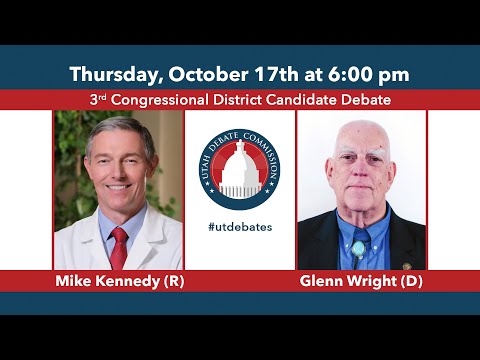
Brigham Young University, Provo — Republican Mike Kennedy and Democrat Glenn Wright faced off in a Utah Debate Commission forum where the candidates outlined sharply different approaches to housing affordability, immigration enforcement, federal budgeting and technology policy.
The most pointed exchanges came on border security and immigration. Glenn Wright argued that the country needs a comprehensive approach that addresses the root causes of migration, increases legal immigration to supply workers and expands rehabilitation and counseling to reduce drug demand. "We need more workers in the system," Wright said, adding that legal immigration helps the economy and referencing the Utah Compact as a model for welcoming newcomers. Mike Kennedy said the nation faces a "porous" border and tied that gap to the flow of fentanyl into American communities, urging improved enforcement and technological screening at ports of entry: "We don't even know who these people are," Kennedy said, describing fentanyl as entering the country alongside other illicit flows.
Housing and tenant protections featured as recurring topics. Student questioner Savannah Purseglove asked how to make rentals fairer in Provo; Wright called Utah's three-day eviction rule "ridiculous" and said county inspections helped prevent unfair evictions in Park City-area cases he described from his time on the Summit County Council. Kennedy pointed to land supply constraints — saying roughly 70% of Utah land is controlled by the federal government — and urged tools that would let local authorities acquire contiguous land and reduce tariffs and taxes on building materials. He endorsed legislation he called the "Houses Act" as a vehicle to allow local land acquisition for housing.
On federal fiscal policy, both candidates said entitlement spending drives long-term deficits but proposed different solutions. Wright cited advisers who told him "87% of the future budget deficits are coming from entitlements" and suggested removing the Social Security payroll tax cap to extend solvency. Kennedy, a state legislator, emphasized identifying fraud and waste in Medicare and Medicaid and pledged to oppose omnibus spending bills in favor of "regular order" budgeting. "I will not vote for omnibus budget bills," he said.
Both candidates welcomed innovation around artificial intelligence and called for balanced rules. Kennedy advocated a light regulatory touch and the use of regulatory sandboxes so new businesses can develop without inappropriate constraints. Wright said the U.S. must lead in AI while preparing the education system for workforce changes and urged strict controls over military uses of autonomous systems.
Energy and water drew district-specific proposals. Wright highlighted geothermal potential in the Uinta Basin and called for federal investments in irrigation optimization and water-right purchases to support the Great Salt Lake and Colorado River basins. Kennedy called for leveraging all of Utah's resources — including geothermal, nuclear, solar and wind — and said federal funds should be sought for Olympic-era infrastructure that could deliver long-term benefits to the state.
On health-care workforce concerns after the Dobbs decision, Wright proposed scholarship programs or a medical corps that would require rural service for recipients; Kennedy said expanding the roles of physician assistants and nurse practitioners and increased medical training capacity (he praised BYU's new medical school) could help fill gaps.
The debate closed with one-minute statements from each candidate and a reminder from the moderator that Election Day is Tuesday, Nov. 5. After the formal program, a brief on-stage exchange continued: Wright called one of Kennedy's answers "a good line of b s" and made sharp accusations tying Kennedy to support for former president Donald Trump; Kennedy said he found a later private remark "shocking" but declined to elaborate.
The forum was moderated by Leah Murray and sponsored by the Utah Debate Commission with venue support from BYU and underwriting from local foundations. Recordings of the debate are available at utahdebatecommission.org.
The campaign is ongoing; both candidates framed their proposals as priorities they would pursue if elected and asked voters for support ahead of the Nov. 5 election.