Get Full Government Meeting Transcripts, Videos, & Alerts Forever!
Get email alerts on the Workplace Safety topic
No spam. Unsubscribe anytime.
Presenter Mike Stagg outlines confined‑space hazards, monitoring and rescue steps
Summary
In a Utah Government Trust training webinar, presenter Mike Stagg summarized OSHA definitions, monitoring thresholds (O2, CO, H2S), permit and recordkeeping expectations, ventilation and rescue planning, and urged treating all confined spaces as permit‑required to reduce fatalities.
Mike Stagg, a presenter for Utah Government Trust, delivered a concise training session on recognizing and safely entering confined spaces, emphasizing monitoring, permits and rescue planning.
Stagg opened by noting the scale of the risk: “rescuers account for over 60 percent of all confined space fatalities,” and said hazardous atmospheres were a leading cause of deaths. He urged workers and supervisors to pause and evaluate why an occupant in a vault or manhole became incapacitated before attempting a rescue.
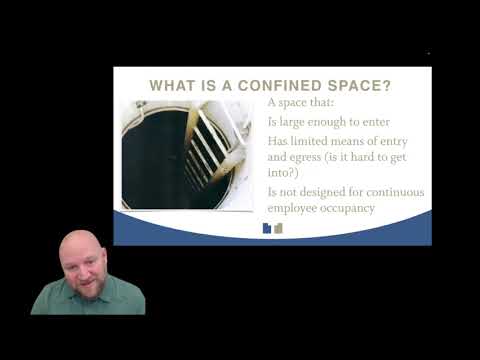
The presentation reviewed OSHA’s criteria for a confined space: an area large enough for a person to enter, with limited means of entry or egress and not designed for continuous occupancy. Stagg listed common examples — manholes, tanks, vaults, silos, digesters and ducts — and said an enclosure that can contain a hazardous atmosphere, engulfing material, a configuration that can trap entrants, or any other recognized serious hazard should be treated as permit‑required.
On entry controls, Stagg emphasized that any breach of the plane of entry (for example, placing a hand inside an opening) qualifies as an “entry” that requires applicable permit controls. He described the key elements of a permit program: identification of a competent person with authority to make safety decisions, a designated entry team (authorized entrants, attendants, supervisors and rescue personnel), documented gas testing and ventilation steps, and retention of canceled permits for at least one year with periodic reviews.
Stagg gave numeric monitoring thresholds used in routine four‑gas or three‑gas meters: normal air at roughly 20.9 percent oxygen; oxygen‑deficient atmospheres at less than 19.5 percent; oxygen‑enriched atmospheres above 23.5 percent; and immediately dangerous to life or health (IDLH) conditions at roughly 16 percent oxygen or lower. He recommended checking oxygen first, then flammability and specific toxic gases such as carbon monoxide (action level cited at 25 parts per million) and hydrogen sulfide (action level cited at 10 ppm). Stagg warned that odor is an unreliable indicator of hydrogen sulfide at higher concentrations — “it shuts off the olfactory responses in the nose,” so meters are essential.
For corrective action, Stagg recommended ventilation and continuous monitoring: once ventilation or air replacement is started it must be maintained throughout the entry, and air intake points must be located away from contaminant sources such as vehicle exhaust. He said bump testing and calibration of meters — including adjustment for site elevation — are required before each entry.
On rescue, Stagg cautioned against assuming outside emergency services are trained or equipped for confined‑space rescue and described such responses as often multi‑agency and time‑consuming. He urged planning for self‑rescue: entrants should wear inspected harnesses with retrieval lines anchored to fixed points or retrieval units (not to a vehicle), and any confined space deeper than 5 feet must have a mechanical retrieval device (tripod, davit arm and winch) available.
Stagg closed by urging consistent use of permits and documentation and encouraged attendees to sign up for the upcoming OSHA 10 training that will cover confined‑space procedures in greater depth. No formal votes or policy actions were taken during the webinar.
The Trust’s presenter said the guidance is intended to reduce on‑the‑job fatalities and to make permit and rescue planning routine for any confined‑space entry.