Get Full Government Meeting Transcripts, Videos, & Alerts Forever!
Get email alerts on the Land Use And Planning topic
No spam. Unsubscribe anytime.
Council previews Zone Ogden code overhaul, debates phased implementation and household definition
Summary
Council and consultants discussed the draft Zone Ogden code rewrite, debated implementation strategies (immediate adoption vs. delayed effective date vs. pending ordinance), and considered substantive changes including replacing the term "family" with "household" (allowing up to 15 occupants and limiting rental contracts), tighter adult‑oriented business definitions, and aligning landscaping rules with Weber Basin rebate standards.
The Ogden City Council spent a large portion of its Nov. 18 work session reviewing draft elements of the Zone Ogden zoning code overhaul and giving staff and consultants direction on public outreach and implementation timing.
John Jansen, the consultant leading the code rewrite team, told council members the draft is "pretty far along" but that the city still needs to decide how to implement the new code. Jansen outlined three transition approaches: adopt and make the code effective immediately; adopt with a delayed effective date (three to six months) to cushion the transition; or use a pending‑ordinance approach that requires projects to comply with both the existing and draft codes. He said from a staff and consultant perspective they prefer a "relaxed" adoption with a delayed effective date to avoid abrupt disruption for applicants.
Council members extensively questioned several substantive policy proposals. On the household definition, the draft would replace "family" with "household," allowing up to 15 occupants in a dwelling but limiting occupancy to a maximum of three separate rental contracts per house. Jansen said the intent is to reflect modern living arrangements and avoid Fair Housing Act conflicts. Several council members raised concerns about enforcement, small homes being over‑occupied, parking and sanitation effects, and the need for square‑footage or bathroom‑based limits. Jansen and other staff said enforcement would likely remain complaint‑driven and include reasonable accommodations for disabled residents.
The draft also proposes tightening definitions and siting for adult‑oriented businesses (SOBs). Jansen discussed moving from older terms ("adult bookstores/videos") toward an "adult retail" floor‑area definition and suggested reducing the threshold that counts a business as adult‑oriented; planning commission members favoured keeping the current 15 percent floor‑area threshold and improving definitions rather than immediately lowering the cap. Council members emphasized the importance of locating any adult‑oriented uses away from schools and pedestrian school routes.
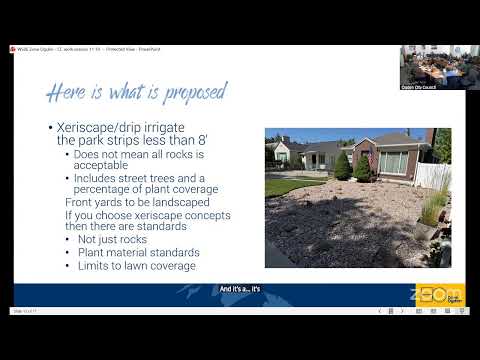
Landscaping standards were another major topic. City staff proposed aligning code language with state and Weber Basin water‑conservation rules, which require turf areas smaller than 8 feet to meet xeriscape and drip irrigation standards to be eligible for rebates. Jansen presented options including allowing a maximum turf percentage in front and side yards (around 35 percent in draft examples) and specifying standards for park strips and planter boxes. Council members asked staff to negotiate with Weber Basin on rebate/title encumbrance mechanics and to preserve flexibility for corner lots.
Jansen told the council the team will return in January for multiple work sessions to continue reviewing chapters and to prepare for the formal planning commission public hearings. No final votes were taken during the work session; the consultant and staff sought direction on advertising, open‑house timing and additional public outreach materials.
What happens next: staff and consultants will return in January for additional work sessions and will carry public engagement materials and an open‑house plan into the public hearing phase.