Get Full Government Meeting Transcripts, Videos, & Alerts Forever!
Get email alerts on the Transit Station Plan topic
No spam. Unsubscribe anytime.
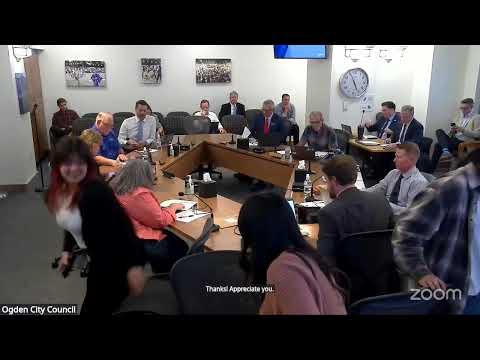
Ogden staff outlines FrontRunner station‑area plan under House Bill 462
Summary
City staff told the council the FrontRunner station‑area plan required by House Bill 462 largely aligns with existing Ogden planning and will focus on housing, environment and transportation within a half‑mile radius of commuter‑rail stations; staff said the city must demonstrate active progress for certification.
Brandon, a city staff presenter, reviewed the FrontRunner station‑area plan and how it responds to Utah House Bill 462, which requires station‑area plans for fixed‑guideway transit stations. He said the law requires a half‑mile radius for commuter‑rail stations and a quarter‑mile for bus rapid transit stations with dedicated lanes, and that Ogden has six stations subject to the requirement.
Staff said the station‑area plans must address four objectives set by HB462: increase availability and affordability of housing (including middle‑income housing), protect environmental conditions, improve transportation connections (walkways and road links) and promote jobs/retail/education opportunities. "This one's a little different than other station area plans," Brandon said, adding the FrontRunner plan emphasizes those statutorily required objectives.
Council members asked what constitutes a station versus a stop; Brandon clarified HB462 applies to "public fixed‑guideway public transit stations" — dedicated commuter or light‑rail tracks or BRT with a dedicated lane — and that stops on shared lanes are not covered by the law. He said many existing Ogden plans already promote the bill's objectives and that the city does not necessarily need wholesale changes to receive certification, but must demonstrate active progress toward the objectives.
Staff noted state incentives such as Housing, Transit and Reinvestment Zones (HTRZs) can encourage development near stations and may require density minimums (staff cited a 50‑units‑per‑acre example for qualifying HTRZs). Because several Ogden FrontRunner stations are close together, staff said the city may use a corridor approach rather than separate plans for each station; projects in overlap areas could be counted in multiple station plans.
Brandon told the council the plan will return to the council in the coming weeks and that he will also present it to the Wasatch Front Regional Council after local consideration. The council did not take action at the work session; next steps are formal packet presentation and subsequent public hearing processes.