Get Full Government Meeting Transcripts, Videos, & Alerts Forever!
Get email alerts on the Budget topic
No spam. Unsubscribe anytime.
West Valley City reviews tentative FY2026 budget; council weighs property tax increase to cover public safety shortfall
Summary
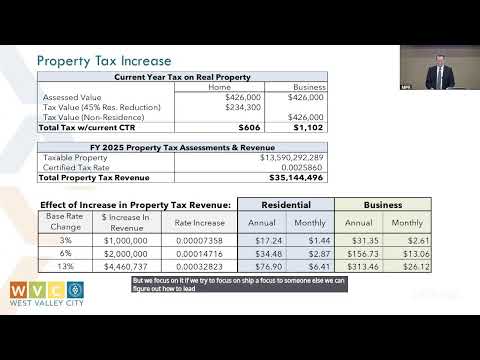
City staff presented a tentative FY2026 budget with a $120 million general fund and a roughly $4.4 million gap to balance. Councilors debated using reserves, selling assets or a 6% property tax increase (estimated to raise ~$2 million) largely to fund public safety needs, including firefighter staffing and equipment.
Mayor called the West Valley City Council study meeting to order at 4:32 p.m. and turned the floor to Mister Welch for a presentation of the city’s tentative FY2026 budget.
"This year's budget is proposed at, the general fund is a hundred and $20,000,000," Mister Welch said, adding the total city budget is approximately $195 million. Welch said the general fund’s projected revenue mix is roughly 39% sales tax, 30% property tax and 31% utility and fee revenue, and that the city must adopt a tentative budget now under state statute.
Welch said 54% of the general fund budget is allocated to public safety—19% fire and 35% police—and listed $3.2 million in new public‑safety investments driven by required contractual increases and an assessment to the Valley Emergency Communications dispatch (VEC) of $220,000. He described proposed use of reserves or other revenue adjustments to cover a $4.4 million difference between revenues and expenditures.
The council discussed options to close the gap. Mister Peely framed the choice as using reserves, cutting services, selling one‑time assets, or raising recurring revenue. One proposal discussed was a 6% property tax increase that staff estimated would generate about $2 million annually; proponents said that revenue is easier for voters to accept when tied to public safety.
Several council members and the city manager emphasized limits and tradeoffs. One councilmember warned that selling city assets generates one‑time money and cannot sustainably fund ongoing expenses. Another councilmember stressed potential impacts on seniors and fixed‑income residents, noting the need for mitigation strategies if taxes rise. Staff noted some expenditures—land acquisition, body cameras, equipment—are one‑time costs, while firefighter staffing and other personnel increases are ongoing.
There was no final vote on the tentative budget or on a property tax change at the study meeting; staff said the council will continue review at upcoming study sessions and required public hearings. Welch also reminded the council that a public hearing is now required for tentative budget adoption following a law change in 2024.
The council scheduled further consideration at study and regular meetings in early May, with staff continuing to evaluate reserve use, possible asset sales, grants and phased tax increases as part of final budget preparations.