Get Full Government Meeting Transcripts, Videos, & Alerts Forever!
Get email alerts on the Animal Control Ordinance topic
No spam. Unsubscribe anytime.
Barren County magistrates debate clearer wording, penalties in proposed animal-control ordinance
Summary
Magistrates in Barren County held a special meeting to review a proposed amendment to the county animal-control ordinance, focusing on definitions, enforcement discretion, fines and impoundment procedures; officials emphasized the change is largely clarifying language and not meant to broaden routine enforcement.
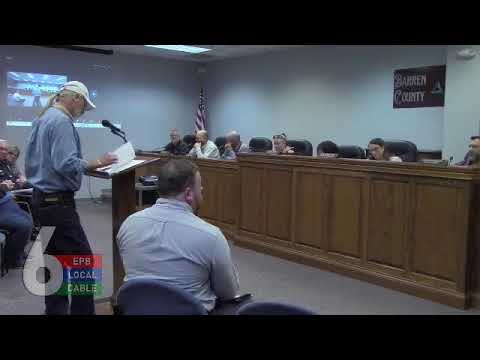
Barren County Fiscal Court opened a special-called meeting on Feb. 9, 2006, for a first reading of a proposed amendment to the county's animal-control ordinance and a broad discussion of enforcement, definitions and penalties.
Chief Howie, who led the presentation for animal-control staff, said the draft is “a cleanup in addition to an already existing ordinance” and stressed the proposal targets "excessive barking" rather than ordinary animal behavior. He told magistrates that animal-control responses are complaint-driven and that officers generally seek voluntary compliance rather than immediate citations.
"Last year in 2025, animal control responded to 1,484 calls for animal control complaints in Barren County. Of those ... there was only 187 citations issued," Chief Howie said, arguing that most contacts lead to compliance not prosecution. He and prosecutors present said officers exercise discretion and that many statutory penalties are resolved in district court, not via automatic fines.
Magistrates raised multiple concerns about the ordinance's language. Several said the bill's wording — particularly the phrases "any person found to be violated" and references to "offense" — could be read to impose automatic fines for isolated incidents such as a farmer whose cow escapes after a fence is damaged. County officials responded that the citation process requires proof in court and that statutory sentencing guides any fines or jail time.
A common point of contention was whether animal-control officers would have peace-officer powers under the ordinance. A magistrate asked whether officers attended a police academy; Chief Howie and others said the Kentucky Revised Statutes (KRS) grant limited peace-officer authority in specific circumstances and that DOCJT training is not provided to civilians unless they are hired as sworn law-enforcement officers.
Magistrates and county attorneys also discussed differences between city and county rules — such as city limits on roosters and containment — and said the county must account for new subdivisions and neighborhoods that now resemble urban settings. Prosecutors said the updated language aims to clarify "nuisance" standards (for example, behavior that "disturbs the peace and quiet of any person") and to provide clear evidence criteria for court proceedings.
Livestock and road-safety complaints were a separate focus. A county law-enforcement speaker reported about 170 calls per year for cattle out on public roadways, noting many repeat addresses and attributing most incidents to poor fencing rather than intent to neglect. Magistrates urged that the ordinance preserve common-sense discretion to avoid penalizing farmers for one-time accidents.
Officials described impoundment procedures and the use of contracted shelters for seized animals, and discussed whether to publish animal-pickup notices on social media to help reunite pets with owners. Budget concerns arose: a magistrate said the county shares animal-control costs with Glasgow and noted the program is not inexpensive.
A resident, who identified himself as Ernie during the permitted two-minute comment, criticized several specific changes — including statute cross-references and time limits for removing venomous reptiles — and asked for clarification on shared fence-responsibility under KRS.
No final vote on the ordinance was taken. Magistrates approved routine minutes earlier in the meeting and voted to adjourn; the chair said the second reading and any final vote on the ordinance will occur at the next fiscal court meeting.
The discussion repeatedly emphasized that the amendment is intended to clarify enforcement thresholds and procedures, but several magistrates asked county attorneys to revise wording to ensure that first-time, accidental incidents (for example, a cow that escapes due to a broken fence) would not be treated as automatic offenses.