Get Full Government Meeting Transcripts, Videos, & Alerts Forever!
Get email alerts on the Public Private Partnerships topic
No spam. Unsubscribe anytime.
GoBiz webinar spotlights public-private partnerships as a tool for regional job and infrastructure projects
Summary
At a GoBiz-hosted California Jobs First webinar, Sunstone Cities CEO John Keisler outlined how public-private partnerships, private capital and state programs can finance regional projects from local arts districts to large civic infrastructure such as the Long Beach Civic Center and aerospace 'Space Beach' cluster.
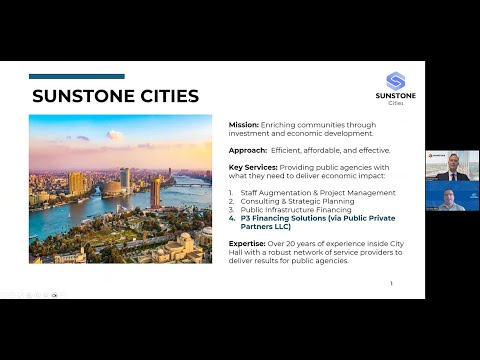
Bridal Coleman, project financing manager with the Regional Economic Development Initiatives team at the Governor’s Office of Business and Economic Development, opened a California Jobs First webinar and introduced John Keisler, CEO and managing partner of Sunstone Cities, who framed public-private partnerships (P3s) as flexible financing tools for projects of many sizes.
Keisler said governments lead with policy, procurement and incentives to derisk investments and urged local officials to pair those public anchors with private capital. "Public private partnerships can can be big, you know, like Space Beach. They can be, big, infrastructure projects like the Long Beach Civic Center, but they can be tiny tiny business development strategies," he said, illustrating that P3s range from accelerator-backed start-ups to multibillion-dollar infrastructure.
Keisler offered California case studies. He described the Long Beach transition of a former Boeing manufacturing site into a space cluster dubbed "Space Beach," where local rezoning, workforce grants and state incentives helped attract firms including Rocket Lab and Relativity Space. He said coordinated actions with GoBiz, workforce programs and university partnerships increased property value and supported job creation. Keisler also described the Long Beach Civic Center as a P3 delivered with private development—he cited a roughly $600 million private-development value and said the city avoided issuing new municipal bonds while using an availability payment to compensate private partners over time.
On smaller-scale applications, Keisler explained how licensing agreements, business-improvement districts and targeted grants can fund arts, parks and community facilities while preserving public access. He pointed to the Long Beach Accelerator and other iHub/accelerator programs across California as models that connect universities, governments and private capital to scale startups and workforce pipelines. Keisler noted workforce funds such as the Employment Training Panel and EDA grants as mechanisms to underwrite training tied to industry needs.
Audience Q&A covered rural energy projects financed with USDA loans and EB-5 participation, the types of private investors that target infrastructure and clean energy, and community engagement strategies necessary to build public support for P3s. Keisler emphasized early education, district-level outreach and risk-sharing terms (availability payments, performance standards) to align public expectations with private delivery.
The session closed with Coleman noting that the recording and slides will be shared and announcing the next webinar in the series on tax increment financing scheduled for September 11.