Get Full Government Meeting Transcripts, Videos, & Alerts Forever!
Get email alerts on the Community Benefits Permitting topic
No spam. Unsubscribe anytime.
GOBIZ releases draft guide to align community benefits with large clean-energy projects
Summary
The California Governor’s Office of Business and Economic Development (GOBIZ) and consultants E3 and GHD presented a draft guide and toolkit to help local planners manage permitting and community benefits for large clean-energy projects; public comments are requested by Oct. 10.
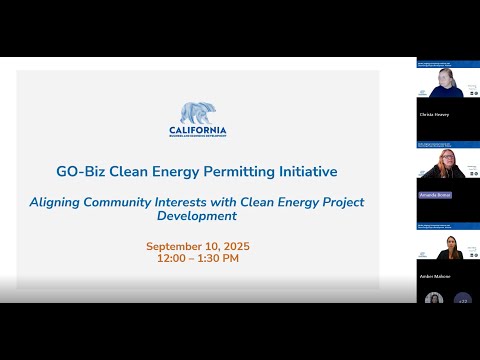
The California Governor’s Office of Business and Economic Development (GOBIZ) on the webinar introduced a draft guide, “Aligning Community Interests with Clean Energy Project Development,” intended to help local planning authorities streamline permitting and incorporate community benefits for large solar, battery storage and onshore/offshore wind projects. Rohima "Mali" Mali, deputy director for energy and climate at GOBIZ, said the effort supports the state’s goal of 100% carbon-free electricity by 2045.
The guide and accompanying toolkit, developed with consultants GHD and E3, synthesize input from roughly 200 surveys and more than 80 in-depth interviews with local planners, developers, community-based organizations and tribes. "Just under half of planners feel equipped to handle the influx of permit applications," Amber Mahone, partner at E3, said on the webinar. The materials include draft model ordinances, application checklists and fact sheets aimed at helping local permitting authorities manage an anticipated near-term influx of projects.
Presenters highlighted permitting, environmental review and community opposition as the principal sources of project delay. The guide stresses early incorporation of community interests to limit conflict and reduce timeline extensions. It outlines three approaches to community benefits: nonbinding community benefit plans, legally binding community benefit agreements (CBAs) and project labor agreements (PLAs). Krista Heavey, associate director at E3, said CBAs can be required under the Energy Commission’s AB 205 opt-in certification process, while they generally are not mandatory in local permitting.
The presenters also reviewed how tax revenue and other local benefits accrue. Krista Heavey cited a research example in the guide estimating the Darden clean energy project could provide about $232,000,000 in property tax revenue over 10 years. Speakers noted that a current exclusion for new solar systems from property-tax assessments will begin to expire on 2027-01-01, increasing property-tax revenue from future solar projects. The guide describes mechanisms—to the extent allowed by law—to direct tax-derived funds to local initiatives, including payment-in-lieu (PILOT) pilot arrangements and enhanced infrastructure financing districts (EIFDs), but presenters said both approaches would require either legislative action or special local approvals and face legal and administrative constraints in California.
On communications, the guide recommends local planning authorities coordinate with community-based organizations, translate materials when necessary and provide quantitative impact studies where feasible so residents can better understand how projects affect local jobs, tax revenue and air quality. Krista emphasized a coordinated community process—coalitions and facilitated engagement by local authorities—can reduce uncoordinated demands on developers and minimize delays.
Availability and next steps: the draft guide presented on the webinar is available via the link shown in the presentation; the full permitting playbook and toolkit were described as due later in the year (Oct/Nov timeframe in the webinar). Presenters invited public comments on the materials to energyunit@gobiz.ca.gov by Oct. 10 and announced related webinars on Sept. 17 and Oct. 15.
The webinar concluded with a Q&A in which presenters answered questions about the toolkit release schedule, coalition-building examples and whether the toolkit would include economic calculators (the team said no custom calculator was produced but they may point to existing tools in the playbook appendix).