Get Full Government Meeting Transcripts, Videos, & Alerts Forever!
Get email alerts on the Cip Financing topic
No spam. Unsubscribe anytime.
Alexandria presents $2.08 billion, 10‑year CIP; staff says plan stays within self‑imposed debt limits but faces tight capacity in late 2020s
Summary
City staff presented a $2.08 billion, 10‑year Capital Improvement Program and a $205.9 million FY26 capital budget, emphasizing state‑of‑good‑repair work and no net increase in long‑term borrowing while warning of tight debt capacity around FY29–31 and potential bond‑market risks.
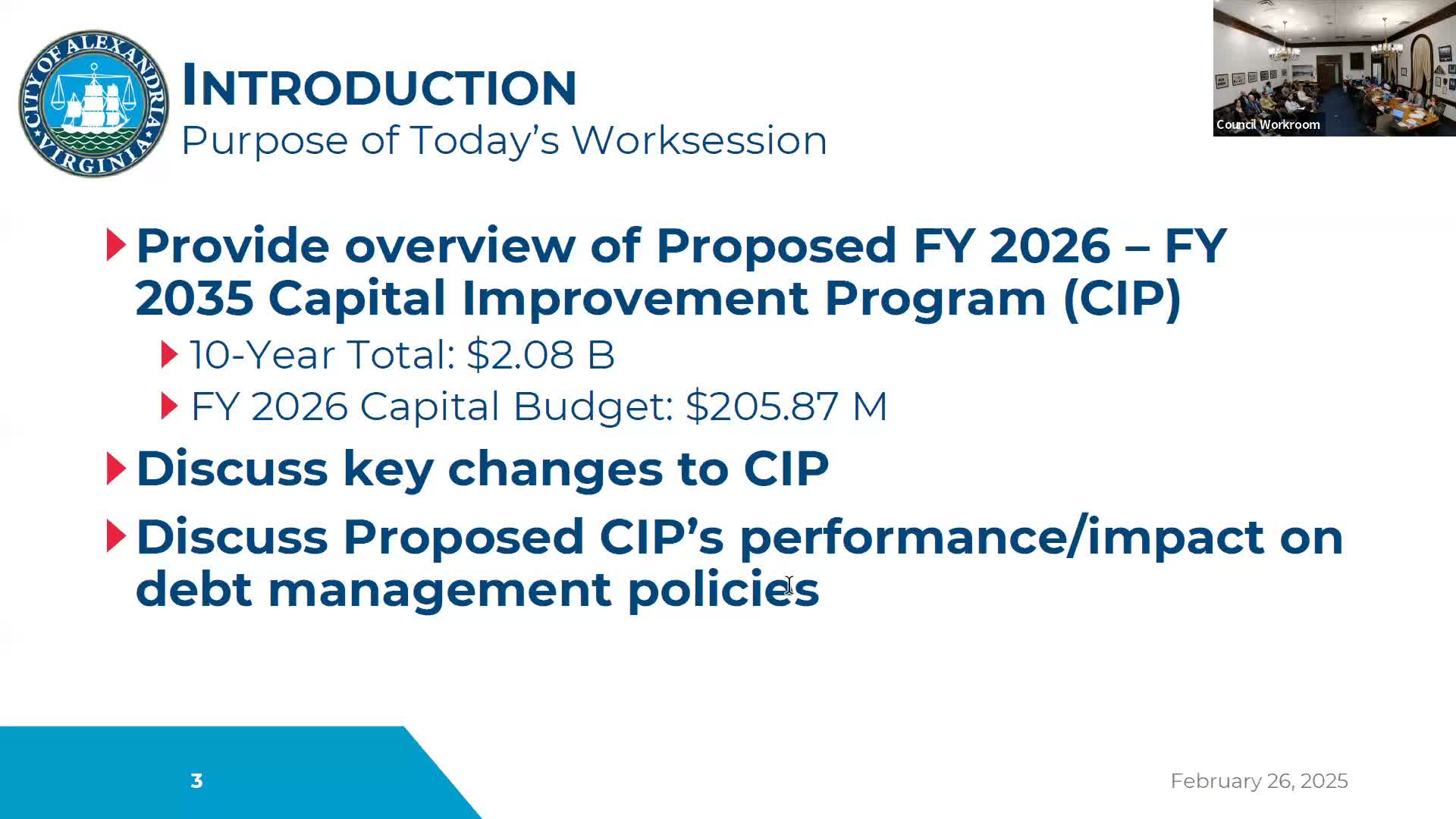
City staff on Tuesday outlined the manager's proposed 10‑year Capital Improvement Program (FY26–35), a $2,080,000,000 plan with a year‑one capital budget of $205,900,000. "That's a 10 year funding total of $2,080,000,000, and a year 1 capital budget of $205,900,000," Arthur Wicks, who oversees the CIP in the Office of Management and Budget, told the council.
Wicks said the plan continues previously approved projects and prioritizes investments that maintain city assets and schools. He emphasized the proposed program was funded largely through internal reprioritization and that staff did not propose a net increase in long‑term borrowing for the 10‑year horizon.
Staff described the overall funding mix: about 46% of the CIP will be paid with cash sources and the balance with borrowing and restricted sources. For FY26, the proposed split is roughly 44% cash and 56% borrowing, with dedicated revenues (about $36 million) and state and federal grants (about $20 million) also contributing.
On fiscal management, staff said the proposed CIP complies with the city's debt management policies but warned council that the tightest window of remaining debt capacity occurs in FY29–31, when projected outstanding debt moves close to the city's policy cap. "Fiscal 29 to 31 is where we're really still the tightest there," Wicks said, urging continued monitoring of the metrics.
Council members asked about market threats to municipal borrowing. A bond‑market expert on the call warned of national discussion about changes to the tax‑exempt status of municipal bonds, saying the loss of tax exemption could raise the cost of taxable financing by roughly 20% for bond‑funded portions of the CIP — a material risk staff will continue to track.
Staff committed to follow‑up materials on project‑level cash flows, the sources‑and‑uses table in the CIP document and scenario analysis for market and revenue sensitivities. The council deferred final appropriation steps to the upcoming legislative dockets and asked for detailed memos on specific program trade‑offs.