Get Full Government Meeting Transcripts, Videos, & Alerts Forever!
Get email alerts on the Concurrent Enrollment Credentialing topic
No spam. Unsubscribe anytime.
Study: Stipends, not just standards, influence whether high-school teachers meet HLC dual-enrollment requirements
Summary
On a Midwestern Higher Education Compact webinar, Ivy Tech researcher Mark Schneider said his dissertation interviews found instructors who received or expected stipends were far more likely to complete the graduate coursework required by HLC credentialing standards; he recommended district-level incentives and state funding to expand the instructor pool.
Mark Schneider, assistant vice president for K'14 academic initiatives at Ivy Tech Community College, presented research showing that financial incentives strongly affect whether high-school teachers complete graduate coursework required by Higher Learning Commission (HLC) credentialing clarifications for concurrent (dual) enrollment instructors.
In a Midwestern Higher Education Compact webinar, Schneider summarized interviews with nine instructors and 16 high-school administrators in Indiana. "So stipends make a difference," Schneider said, describing a pattern in which instructors who received or expected stipends were far more likely to finish the additional courses the HLC standard required. Schneider told participants that of the potential pool tied to his institution, 130 were eligible but only nine agreed to be interviewed for the qualitative study.
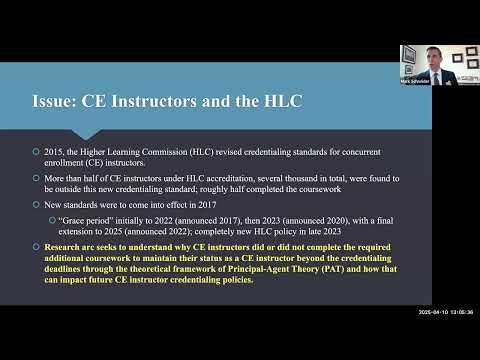
The research traced the HLC's 2015 clarification of credentialing standards, the subsequent grace periods and extensions (first standards due in 2017, extended through 2022 and 2023, with a final extension to 2025) and a November 2023 policy change that returned more credentialing authority to institutions. Schneider said the policy shifts matter for transferability and for how states and institutions design incentives.
Schneider reported consistent themes across interviews. All nine instructors described themselves first as high-school teachers rather than college faculty, which shaped where they look for support and incentives. He also said many administrators felt the credentialing rollout was poorly communicated and, in some cases, viewed the changes as higher education protecting revenue rather than improving instruction: "It was nothing more than a cold calculated business decision," he said administrators told him.
Administrators' practices varied. Schneider cited examples of stipends ranging from about $500 per year to $500'$1,000 per course and said 11 of 16 administrator participants reported some financial incentive in their district. Where unions or collective bargaining blocked stipends, local adoption lagged. Schneider used principal-agent theory to argue that stipends paid through school districts, rather than only by higher-education partners, are likelier to change teacher behavior because teachers view districts as their primary employers.
Schneider acknowledged the study's limitations: it drew from a single-state context and a small interview pool, and participants may have self-selected. Still, he recommended that states consider dedicated appropriations or credit-hour reimbursements to high schools to underwrite stipends or teacher-sharing models. Schneider pointed to Indiana's recent policy changes as an example: the state passed legislation to put high schools on a three-year track to offer the Indiana College Corps, a 30-credit transfer block, and the 2020'era budget included a $40-per-credit-hour reimbursement to high schools for gen-ed dual-credit courses, funds local leaders could use to support stipends.
Ivy Tech, Schneider added, is NACEP-accredited and supports a large dual-credit operation: he cited nearly 100,000 dual-credit students statewide, more than 3,300 dual-credit instructors and over 500 college faculty who supervise and support those instructors. Schneider said further quantitative work would help answer how much different stipend levels move the needle and which demographic or career-stage groups are most responsive.
The Midwestern Higher Education Compact will share Schneider's dissertation and papers in the webinar chat and plans further analysis; Schneider said he expects a related paper this summer and that he is available for follow-up questions by email. The webinar host closed by noting upcoming MAC webinars on Graduate Credit Quest and dual-enrollment funding models.