Get Full Government Meeting Transcripts, Videos, & Alerts Forever!
Get email alerts on the Compliance Practices topic
No spam. Unsubscribe anytime.
How colleges should prepare: inventory programs, update student‑location policies and set up attestation
Summary
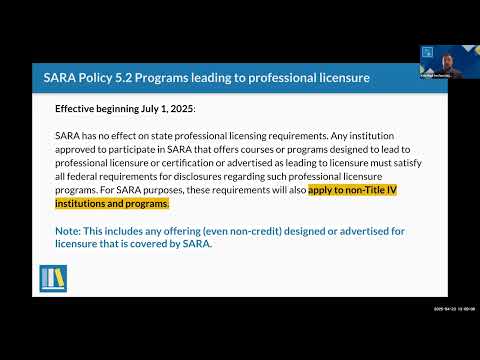
Webinar presenters advised colleges to inventory licensure‑related offerings, revise student‑location policies, document state comparisons, implement a written‑attestation process (one named state), and prepare direct‑disclosure workflows before the SARA change and ongoing Title IV enforcement.
Community and technical colleges should take immediate, practical steps to comply with the Title IV certified responsibility and the upcoming SARA policy change, consultants said.
Chris Small of Higher Education Licensure Pros recommended a structured, documented compliance workflow: (1) inventory all programs and offerings that could be licensure‑related (including noncredit workforce and certificate programs offered across state lines); (2) adopt or revise a student‑location policy that clearly defines the time and method used to determine a student's location for initial enrollment; (3) research and document each state's educational requirements and compare them to program curricula; (4) implement an attestation process and retain signed, process‑evidence documentation; and (5) set up a direct‑disclosure and student‑notification workflow, including the 14‑calendar‑day timeline for notifying current students when a program no longer "meets" requirements in their location.
Small urged institutions to be precise about student‑location rules and to spell out exceptions for populations such as military affiliates or international students. "You can spell that out in your policy," he said, noting some institutions treat on‑campus, face‑to‑face enrollees as located in the campus state even if their permanent address is elsewhere.
On the written‑attestation process, Small said institutions cannot rely on a purely automated checkbox. He described the attestation as a process that includes an exchange of information to ensure the applicant understands the program will not meet requirements where they are currently located and that they intend to seek licensure and employment in one specific named 'meets' state.
Small also advised caution when considering whether a licensure compact or reciprocity agreement suffices for a "meets" determination: compacts typically govern individual licensed practitioners and sometimes require experience before practicing across state lines, so they may not allow immediate licensure for recent graduates. Institutions should document why they accepted a compact as evidence, if they do.
Finally, Small recommended an annual review and strong documentation practices so institutions can produce evidence of how determinations were made if audited by the Department of Education or a state portal entity.