Get Full Government Meeting Transcripts, Videos, & Alerts Forever!
Get email alerts on the Education Dual Enrollment topic
No spam. Unsubscribe anytime.
Midwestern Higher Education Compact debuts upgraded Graduate Credit Quest with free access and UWM analytics pilot
Summary
The Midwestern Higher Education Compact (MEC) showcased a redesigned Graduate Credit Quest (GCQ) site that lists graduate courses for dual-enrollment teachers, offers planning and sharing tools, and is free to users; MEC is underwriting the platform and has launched a pilot with the University of Wisconsin–Milwaukee to test analytics-based recruiting.
The Midwestern Higher Education Compact on a webinar demonstrated a redesigned Graduate Credit Quest (GCQ) website that helps teachers, district coordinators and university administrators find, organize and share graduate-level courses relevant to dual-enrollment credentialing.
In the opening demonstration, Carrie Wandler, director of policy initiatives at the Midwestern Higher Education Compact, said the tool responds to rapid growth in dual-enrollment and the related demand for qualified teachers. "More high school students, more high school teachers who are qualified to teach such courses are needed to meet the demand of the dual enrollment courses," she said.
Jerry Murphy, the GCQ consultant who led the walkthrough, said the upgraded site is built around three audiences—universities, teachers seeking credentialing and district concurrent-enrollment coordinators—and is intended to accelerate teachers’ due diligence and communication with advisers. "The gateway to the site is the finder courses," Murphy said, describing public filters by state, participating university, content area and modality that let users narrow searches and preview course records without an account.
Murphy demonstrated three standard chunks of information on each course record: basic course details, contact information and links to program/enrollment pages. He said those links are intentional so teachers and coordinators can reach the university’s own pages for the most current information, and that university administrators retain control over their own course databases. "All of the institutions that are using this site are accredited," Murphy said, adding that most are aligned with the Higher Learning Commission (HLC) practices reflected in an 18-credit benchmark used in some adjudications.
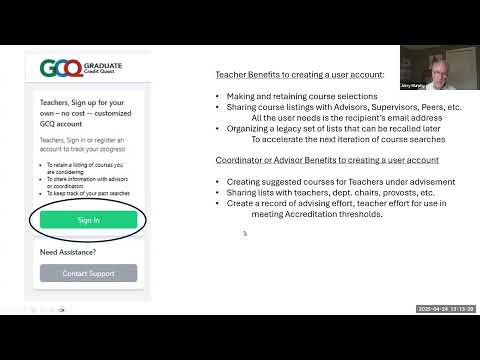
The GCQ includes account-based planning tools so teachers can save named course lists across semesters, perform bulk edits, and share plans by email with advisers or decision-makers. Murphy described bulk uploading via a provided Excel template for administrators who need to publish many courses quickly and said the administrative back office prevents an administrator at one university from editing another institution’s content.
On cost and funding, Murphy stated: "There's no cost whatsoever to the graduate product class. Midwestern Higher Education Compact is underwriting this tool." He said MEC views GCQ as a member-state benefit intended to expand access to vetted course information and to support recruiting strategies for graduate programs.
Murphy also described an early analytics pilot with the University of Wisconsin–Milwaukee (UWM) that links GCQ pathways to university landing pages so institutions can see whether traffic is coming from teachers using the site. For a March 1–31 snapshot, he reported that 39 educators used the site and 14 institutions were publishing courses out of roughly 30 accounts in the system; Murphy noted those numbers vary over time and by calendar cycle.
A community-college question read during the webinar by an attendee identified as Dan McDonald asked how GCQ ensures online courses meet graduate-level rigor and whether in-person courses are available. Murphy replied that modalities (online synchronous/asynchronous and in person) are selectable in course records and reiterated the site’s approach: GCQ provides links, contact names and information so receiving institutions and coordinators can perform final adjudication of rigor and credit acceptance.
The webinar ended with Wandler reminding participants that the session recording and presentation would be posted on the MEC website and inviting attendees to a May 20 event on dual-enrollment funding. The presenters encouraged legacy users of version 1 to reset passwords and new university administrators to complete the validation required to publish courses.
What’s next: MEC plans to continue the UWM pilot, refine analytics and invite other university partners to use site data to inform graduate recruiting and dual-enrollment pathways.