Get Full Government Meeting Transcripts, Videos, & Alerts Forever!
Get email alerts on the Sara Policy Change topic
No spam. Unsubscribe anytime.
SARA to extend licensure‑disclosure rules to non‑Title IV programs; Title IV 'certify' duty already in force
Summary
A webinar from the Midwestern Higher Education Compact warned that an upcoming SARA policy change (effective July 1) will require participating institutions to disclose whether non‑Title IV programs meet state licensure requirements, and reminded colleges that a Title IV certified‑responsibility has been effective since 07/01/2024.
A policy change to the State Authorization Reciprocity Agreement (SARA) will require participating colleges to disclose whether non‑Title IV programs prepare students for state licensure, a webinar hosted by the Midwestern Higher Education Compact was told.
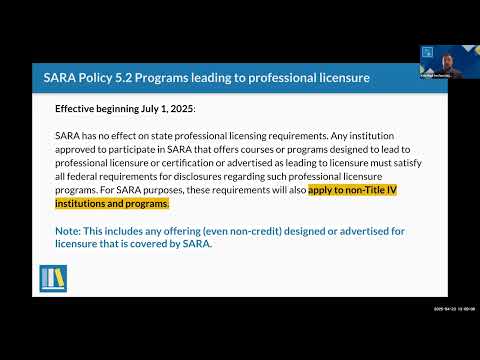
Chris Small, a consultant with Higher Education Licensure Pros (HELP), said the SARA policy update (policy 5.2) that takes effect on July 1 will remove an optional paragraph and extend disclosure obligations beyond Title IV programs to non‑Title IV and even noncredit offerings when those are offered across state lines or include out‑of‑state clinical experiences. "If your college participates in SARA, you will be required to disclose for anything that you're offering that relates to a professional license," Small said.
The timing matters because institutions already face a separate requirement under federal Title IV regulations: a "certify" responsibility that became effective 07/01/2024. That rule requires institutions to be able to certify that licensure‑related programs meet the educational requirements where the institution is located and where distance‑education students are located at the time of initial enrollment. "Institutions must be able to certify today that your programs related to licensure do meet the educational requirements where your institution is located and where your distance education students are located," Small said.
Small described two disclosure types institutions must manage: public disclosures (clear listings on institutional websites of states where a program "meets" or "does not meet" educational requirements) and direct disclosures sent in writing to prospective or current students in specific circumstances. He noted the prior federal guidance allowed a 'not determined' column; the 07/01/2024 Title IV regulations do not require that column, and institutions may list undecided states under "does not meet" with an explanatory footnote or maintain a third column by choice.
The webinar also reviewed the "written attestation" exception to enrollment limits: when a prospective student is located where a program does not meet requirements, the institution may enroll that student if the student goes through a documented process and provides a written attestation that they intend to seek licensure and employment in a specific named "meets" state. Small emphasized the attestation must identify one exact state: "It does need to be one specific named meet state or territory. It's not okay to have a written attestation that just says, 'I'm planning to be licensed somewhere,'" he said.
Small flagged additional items institutions should track: the Department of Veterans Affairs rule tied to institution location (which requires disclosure of additional conditions such as training, experience and examinations), the risk of federal enforcement actions (including loss of federal student aid participation) for Title IV noncompliance, potential loss of SARA eligibility for continued noncompliance, and borrower‑defense claims by graduates who cannot obtain a license. He also cautioned against assuming interstate licensure compacts automatically validate a program: compacts typically address individual practitioners and may require experience or other steps before licensure in another state.
The webinar included multiple concrete compliance timelines: verified certification is required at the time of initial enrollment; direct disclosures to current students are required within 14 calendar days of the institution becoming aware that a student's location or a state's requirements changed to a "does not meet" status; and the SARA policy change will take effect July 1.
The Midwestern Higher Education Compact posted the slide deck and will post the recorded session; HELP said it offers consulting, policy drafting and the 'Bookmark' database covering more than 80 license types across all 59 U.S. states and territories. The compact also scheduled a follow-up presentation with Chris Small on May 21.