Get Full Government Meeting Transcripts, Videos, & Alerts Forever!
Get email alerts on the Higher Education Licensure Compliance topic
No spam. Unsubscribe anytime.
SARA expands licensure-disclosure reach; institutions told to prepare for July 1 changes
Summary
In a Midwestern Higher Education Compact webinar, experts explained that SARA policy will extend disclosure requirements to non-Title IV programs starting July 1 and reviewed Title IV certify and disclosure duties, the written‑attestation exception, the 14‑day disclosure rule for current students, and practical steps for compliance.
CHICAGO — Officials and consultants on higher-education compliance urged college and university administrators to review their licensure disclosures and student-location policies after a webinar outlining federal and SARA changes.
Chris Moll, founder of Higher Education Licensure Pros, said institutions must manage three core responsibilities under the federal Title IV framework: understand how programs meet other states' licensure requirements, certify program compliance under the Program Participation Agreement (PPA), and communicate disclosures to prospective and current students. “Were coming up on a year since this became effective 07/01/2024,” Moll said, referring to the Title IV certify requirement.
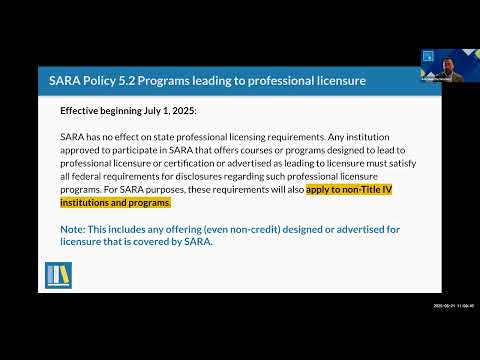
Why it matters: Moll highlighted a SARA policy change taking effect July 1 that will extend disclosure obligations to programs not covered by Title IV. “For SARA purposes, these requirements will also apply to non title 4 institutions and programs,” he said. That expansion can bring noncredit and workforce-training offerings under SARA's disclosure scope when they are offered across state lines or include out‑of‑state clinical placements.
Moll reviewed key operational points institutions should address now. Public disclosures (typically posted on institutional websites) must identify states and territories where a program meets or does not meet educational requirements. Individual direct disclosures must be sent to prospective students whose location triggers a does‑not‑meet determination. For current students who move or whose program no longer meets a state's requirements, Moll said, “For your current students, you have 14 calendar days to send them a direct disclosure, letting them know that something's changed and now they're located somewhere where your program does not meet.”
He also described the Department of Education's written‑attestation exception, which allows an institution to enroll a distance‑education student located in a non‑meets state if the student signs a written attestation — after an interaction with institution staff — that they plan to be licensed and employed in a state where the program does meet requirements.
Practical implementation: Moll emphasized the state‑by‑state nature of licensure research, the need for documented determinations, and a regular review cadence (many institutions choose annual reviews). He warned of enforcement risks tied to noncompliance, including misrepresentation claims, borrower‑defense claims, accreditor review questions, and potential loss of Title IV or SARA eligibility.
Resources and next steps: Moll described a commercial database his firm maintains (the "bookmark"), covering more than 80 license types, as a research shortcut and encouraged institutions to contact his firm or institutional counsel for tailored advice. “With everything changing in the higher education and department of education today, just stay on top of these things,” Moll said.
The webinar closed with a Q&A that addressed student-location policy examples, scenarios for students who move while enrolled, and distinctions between initial licensure and continuing-education or renewal coursework. Organizers said the session was recorded and a post‑session link and survey would be shared with attendees.