Get Full Government Meeting Transcripts, Videos, & Alerts Forever!
More states move to 'state pays' dual-enrollment funding, updated report and MEC webinar finds
Summary
Jennifer Zinth, presenting to the Midwestern Higher Education Compact, summarized a 2025 update to the Funding for Equity report showing increased adoption of state-funded dual-enrollment models and varied state approaches; she cited Idaho and recent Arkansas legislation as examples and highlighted reporting and implementation trade-offs.
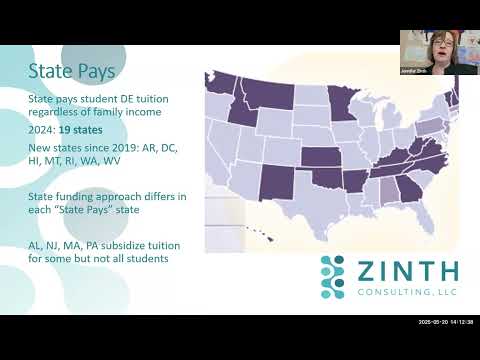
Jennifer Zinth, founder and principal of Zinth Consulting, told a Midwestern Higher Education Compact webinar that more states are adopting funding models that remove tuition charges for high-school students taking college courses.
Zinth, lead author of an updated Funding for Equity report (original 2019, updated February), said 19 states now use some form of a "state pays" model in which students and parents are not charged tuition for eligible dual-enrollment courses. She highlighted Idaho's account-based approach as an example: each public K'12 student has a state account (noted in the presentation as $4,625 per account) that can be drawn down for dual-credit tuition (a statewide standard cited in the webinar as $75 per credit hour) and for AP/IB exam fees or CTE certification costs.
Why it matters: states that pay tuition relieve families of direct costs and simplify administration, Zinth…
Already have an account? Log in
Subscribe to keep reading
Unlock the rest of this article — and every article on Citizen Portal.
- Unlimited articles
- AI-powered breakdowns of topics, speakers, decisions, and budgets
- Instant alerts when your location has a new meeting
- Follow topics and more locations
- 1,000 AI Insights / month, plus AI Chat