Get Full Government Meeting Transcripts, Videos, & Alerts Forever!
Get email alerts on the Dual Enrollment Funding topic
No spam. Unsubscribe anytime.
More states move to 'state pays' dual-enrollment funding, updated report and MEC webinar finds
Summary
Jennifer Zinth, presenting to the Midwestern Higher Education Compact, summarized a 2025 update to the Funding for Equity report showing increased adoption of state-funded dual-enrollment models and varied state approaches; she cited Idaho and recent Arkansas legislation as examples and highlighted reporting and implementation trade-offs.
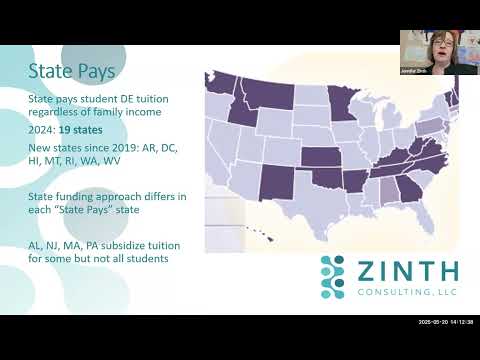
Jennifer Zinth, founder and principal of Zinth Consulting, told a Midwestern Higher Education Compact webinar that more states are adopting funding models that remove tuition charges for high-school students taking college courses.
Zinth, lead author of an updated Funding for Equity report (original 2019, updated February), said 19 states now use some form of a "state pays" model in which students and parents are not charged tuition for eligible dual-enrollment courses. She highlighted Idaho's account-based approach as an example: each public K'12 student has a state account (noted in the presentation as $4,625 per account) that can be drawn down for dual-credit tuition (a statewide standard cited in the webinar as $75 per credit hour) and for AP/IB exam fees or CTE certification costs.
Why it matters: states that pay tuition relieve families of direct costs and simplify administration, Zinth said, because the state reimburses postsecondary institutions directly rather than routing funds through local school districts. That shift, she said, reduces paperwork burdens for districts and increases district willingness to participate.
Zinth also stressed limits and variation within the "state pays" label: some states restrict covered courses or student cohorts (for example, limiting coverage to 11th- and 12th-graders or to specified CTE courses). She noted Arkansas passed legislation that removes all tuition and fees for concurrent-enrollment courses (the presenter said the change was passed in March), meaning Arkansas no longer places students in a low-income-only coverage category.
The webinar summarized seven funding approaches in the 2025 update: state pays; state+district shares; district pays; student pays reduced tuition; local decision/policy silence; and multi-party cost-share variants (state/district/student). Zinth said some states operate multiple models depending on delivery (college campus vs. high-school instructor) and cautioned that the local-decision model (24 states) can create wide disparities across neighboring districts.
Examples and nuances: Zinth described Indiana's approach, where districts receive participation-based weights in the state funding formula and institutions may receive partial reimbursements (presenter cited roughly $50 per credit hour), and noted that policy allows a $25-per-credit charge in some Indiana institutions but that many institutions waive that fee in practice. Washington and Rhode Island were cited as states that were reclassified in the 2025 taxonomy because of recent changes to how costs are allocated.
Implementation considerations: Zinth recommended states consider the program goals and intended participants before picking a model, and to evaluate data on who currently participates and the outcomes produced. She said common policy tools include task forces (Kentucky example), third-party landscape reports (Arkansas example), and agency-led proposals (Colorado P-20 council example). She emphasized stakeholder inclusion (especially districts) and clear charges and timelines for any task force.
The webinar did not include formal votes or policy adoptions by MEC; it was a presentation of research findings and implementation guidance. The report appendix (shown during the webinar) offers a living, alphabetical list of state models and key features for states to consult.
The next step Zinth offered to attendees was follow-up contact and use of the appendix as a resource; the webinar host, Carrie Wandler (Director of Policy Initiatives, MEC), encouraged participants to complete the post-webinar survey and subscribe to MEC updates.