Get Full Government Meeting Transcripts, Videos, & Alerts Forever!
Get email alerts on the Higher Education Data And Outcomes topic
No spam. Unsubscribe anytime.
Iowa Board of Regents official details use of Census PSEO to track college outcomes, warns of enrollment shifts
Summary
Dr. Jason Pontius described how the Iowa Board of Regents uses the US Census PSEO and other datasets to track enrollment, earnings and return on investment, explained privacy safeguards for Social Security numbers, and said state-focused projections suggest Iowa may return to 2022 enrollment levels rather than the deeper national “cliff.”
Dr. Jason Pontius, associate chief academic officer for the Iowa Board of Regents, told a Midwestern Higher Education Compact meeting that the board is using a combination of public datasets — notably the US Census Bureau’s PSEO — to track where graduates go, what industries they enter and how their earnings evolve.
Pontius said the PSEO data allow the board to see percentile earnings (25th, 50th, 75th) and follow graduates at one, five and 10 years after college. "We keep [Social Security numbers] for about a week," he said, describing the process for matching and then purging identifiers on the Census side. "We do not wanna store SSNs. We just do not." The board also combines PSEO with state longitudinal student data and College Scorecard information to assess net price, debt and outcomes by field of study.
Why it matters: national headlines about an "enrollment cliff" often use broad demographic forecasts. Pontius referenced a projection of roughly a 15% national drop in high school graduates but said Iowa’s internal modeling — which tracks first-grade cohorts forward and applies statistical smoothing — produces a less severe outlook. "For the state of Iowa, we're not quite so dire," he said, adding that Iowa’s worst-case projection is a return to 2022 enrollment levels rather than a larger collapse.
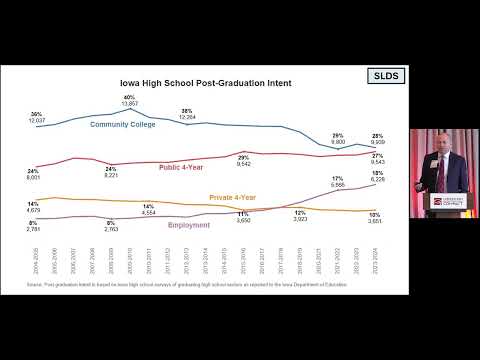
Pontius highlighted several trends the board is monitoring: a decline in the percentage of high-school graduates going straight to college (from about 72% for the class of 2012 to roughly 59% in recent cohorts), a drop in enrollment at some small four-year private colleges (he cited examples of 25% declines), and a cohort of students who neither enroll in college nor report plans to enter the workforce. He noted socioeconomic signals — higher free-and-reduced-lunch rates correlate with lower college-going — and widening gaps by sex and race in who enrolls.
On dual enrollment, Pontius said Iowa has high participation rates and that many incoming Regent students carry substantial college credits (he noted instances of students arriving with as many as 65 credits). He cautioned that not all dual-enrollment credits apply to degree requirements: "We accept all of them, but not all of them can apply." The board’s early analyses show dual enrollment is associated with higher short-term graduation rates and with students pursuing minors or double majors, though faculty have flagged that some students retake high-school-level courses in college.
The board is also using the PSEO flows data to map industry and geographic retention. Pontius said about half of graduates remain in Iowa 10 years after finishing and that key industries retaining Regent graduates include agriculture and finance/insurance. He urged caution when comparing earnings across states or regions because local labor markets, cost of living and industry mixes can inflate differences.
Pontius described efforts to assess return on investment by major. He summarized methodologies used by the Georgetown Center on Education and the Workforce and the University of Texas System’s "minimum economic return" approach, but said the board customizes those formulas using PSEO earnings and actual time-to-degree by major. "For an engineering student ... you've kind of crossed that threshold in the first year," he said; by contrast, he said a philosophy major may take about four years to reach the same break-even point, and a few programs may take seven or eight years to break even.
On participation and privacy, Pontius said Iowa has brought its Board of Regents data, the community college division data and about 10 participating private institutions into the PSEO project, with more private colleges expected to join under MOUs. He acknowledged common concerns — sharing SSNs, the data lift, and the fact that results become public — and described encryption and short-term handling of identifiers as safeguards.
Pontius said the board has repackaged the PSEO and related datasets into one-page public visualizations by academic field and ZIP code and that a state law passed two years earlier requires the board to show wages, debt, and graduate outcomes to students each semester. He said the board will include these analyses in a larger report to the state legislature and make data tools available on the Board of Regents website.
In audience questions, Pontius said the data are being used to inform students earlier in the pipeline (for example, through eighth-grade academic plans), that regional patterns and name-brand effects influence long-run earnings patterns, and that PSEO can include certificates and associate-degree outcomes when states supply those institutions' data. He encouraged further testing of how specific dual-enrollment courses (particularly math and some sciences) translate to college performance.
Pontius closed by inviting follow-up questions and by reiterating that the board aims to give students and policymakers clearer, empirically grounded information about majors, costs and outcomes.