Get Full Government Meeting Transcripts, Videos, & Alerts Forever!
Get email alerts on the Urban Revitalization topic
No spam. Unsubscribe anytime.
Jeanette Pierce lays out collaboration and placemaking lessons from Detroit's revival
Summary
At a Midwestern Higher Education Compact event in Detroit, Jeanette Pierce, founder and president of the City Institute, traced the city's history and outlined concrete lessons in regional collaboration, placemaking and talent retention, citing projects such as Michigan Central and the Joe Louis Greenway.
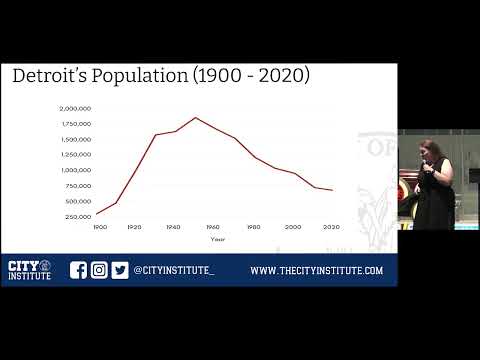
Jeanette Pierce, founder and president of the City Institute, told attendees at a Midwestern Higher Education Compact event in Detroit that the city's recent recovery shows how collaboration, targeted public-space investments and place-based storytelling can support economic revival. "Growth comes with collaboration," Pierce said during a presentation that traced Detroit's history from Indigenous habitation and early European settlement through the rise of the auto industry and the city's later bankruptcy.
Pierce highlighted several concrete projects and figures she said have helped drive momentum: extensive downtown renovations that reuse historic buildings, the Michigan Central area as a focal point for investment, and the Joe Louis Greenway, which she described as a 29-mile greenway connecting parks and neighborhoods. She also noted the Ralph C. Wilson Jr. Centennial Park, a $75,000,000 project opening this fall, as an example of phased public-investment that ties into larger networks such as the Riverwalk.
Pierce emphasized that revitalization depended on rebuilding relationships across municipal boundaries and with state partners. She said the region learned during the Great Recession that cross-jurisdictional cooperation and trust-making are prerequisites for large, multi-stakeholder projects. "You start somewhere, not everywhere," she said, describing the Riverwalk and other phased efforts as proof-of-concept projects that enabled further investment.
A central theme of Pierce's talk was the role of narrative and local assets. She argued that "assets and challenges are not mutually exclusive" and that communities must surface taken-for-granted strengths during storytelling and outreach. City Institute, she said, runs learning journeys and workshops to help residents, new faculty and civic leaders better understand local assets and history; Pierce told the audience she and her team have led approximately 160,000 people on experiential tours over 20 years.
On talent and retention, Pierce said that quality of place matters for where recent graduates and new faculty choose to live. She advised cities to invest in public space and everyday amenities not as an afterthought but as part of broader talent-attraction strategies. "Quality of place isn't something you do after you grow the academy," she said.
Pierce closed by framing crisis as a source of innovation: "Crisis breeds innovation," she said, noting that early successes build trust and unlock new opportunities. She then opened the floor to audience questions.