Get Full Government Meeting Transcripts, Videos, & Alerts Forever!
Get email alerts on the Open Education Certificate topic
No spam. Unsubscribe anytime.
Creative Commons certificate promoted to Midwestern Higher Education Compact members; instructor spotlights OER work
Summary
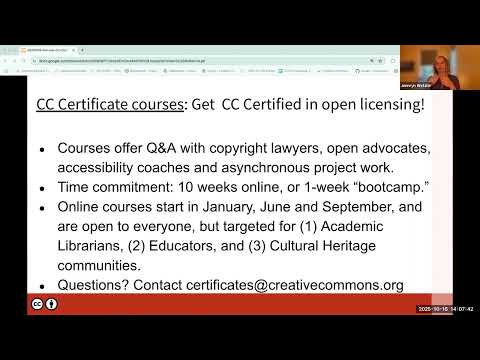
Midwestern Higher Education Compact hosted a webinar with Creative Commons outlining its 10‑week CC Certificate (10‑week online course with optional in‑person bootcamp), a MEC member discount (code MEC15), support services and an instructor case study on creating OER textbooks and a 'z degree' to eliminate student text costs.
The Midwestern Higher Education Compact hosted a virtual webinar where Creative Commons staff described its CC Certificate program and how faculty can use CC licensing to develop open educational resources (OER).
"And this slide deck is obviously open licensed," said Jenarin Wetzel, director of learning and training at Creative Commons, as she outlined the organization’s mission and the structure of the certificate program. Wetzel said the certificate is a 10‑week online course (with optional one‑week in‑person boot camps) that covers copyright, CC licenses, public‑domain issues and recommended open‑education practices.
Wetzel emphasized the time commitment: "please do know 10 weeks online plus about 6 to 10 hours a week on average," and said the curriculum is aimed at educators, academic librarians and cultural‑heritage professionals but open to anyone who wants practical training on licensing and reuse.
The webinar highlighted outcomes reported by alumni: Wetzel said Creative Commons’ alumni community includes about 2,200 people from 71 countries and all 51 U.S. states plus the District of Columbia, and that some alumni credited the certification with helping them win grants or serve as institutional points of expertise for open licensing.
Dr. Kara Woodley, assistant professor of special education at the University of Wisconsin–Superior and a CC certificate alumna, described how she used grant support from her campus to produce an OER textbook for her courses. "And of course it saves our students money, which if we all remember, textbooks can be really expensive," Woodley said, describing work to build a "z degree" that aims to eliminate textbook costs for graduate students in her program.
Wetzel also explained practical supports available to learners and institutions: Creative Commons offers tailored trainings (from one‑hour webinars to multi‑day onsite sessions), office hours with legal counsel (noted as subject to change), a peer Q&A network and a mailing list. She outlined a MEC member benefit: members of the U.S. regional higher‑education compacts (MEC, NEBI, SREB and WICHE) are eligible for a 15% discount; registrants can enter code MEC15 at checkout and (per Wetzel) the discount is expected to be available through January, though final availability is "TBD."
On future work, Wetzel said Creative Commons is monitoring legal developments and the changing landscape of artificial intelligence. She said the organization is exploring interventions called "CC Signals" to give creators more choice over how their works are treated in datasets used for AI. "One of our areas that we are, looking at interventions into is in, something called CC signals," she said.
The hosts said the slide deck and recording will be posted to the MEC website after the event and encouraged attendees to complete a follow‑up survey. Presenters offered to accept additional questions by email or the listed Creative Commons learning contact.