Get Full Government Meeting Transcripts, Videos, & Alerts Forever!
Bellwether report urges states to share dual‑enrollment costs to widen access
Summary
A Bellwether presentation hosted by the Midwestern Higher Education Compact outlined how state funding models—California’s CCAP, Idaho’s Advanced Opportunities, Minnesota’s concurrent enrollment/PSEO mix, and Texas’ targeted program—shape dual‑enrollment access and offered design recommendations to reduce inequities and instructor capacity barriers.
Bellwether Senior Analyst Krista Caput told a Midwestern Higher Education Compact webinar audience that state funding design is a key lever for expanding student access to dual enrollment, and that targeted investments can reduce racial and income gaps in participation. "Dual enrollment, about 16% of high school students participate nationwide," Caput said, noting enrollment has increased by roughly 2 million students since 2015.
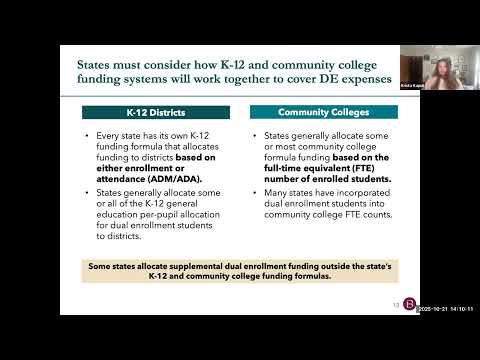
Caput presented findings from Bellwether’s 2025 paper "Sharing the Cost," which reviewed how four states structure tuition and non‑tuition cost sharing among states, community colleges, K–12 districts and students. She emphasized that dual‑enrollment costs include tuition and many non‑tuition items—fees, textbooks, transportation and meals—that affect participation.
Why it matters: Funding that covers student costs tends to increase participation, particularly for systemically marginalized groups, Caput said. She cited Texas’ program that targeted economically disadvantaged students and…
Already have an account? Log in
Subscribe to keep reading
Unlock the rest of this article — and every article on Citizen Portal.
- Unlimited articles
- AI-powered breakdowns of topics, speakers, decisions, and budgets
- Instant alerts when your location has a new meeting
- Follow topics and more locations
- 1,000 AI Insights / month, plus AI Chat