Get Full Government Meeting Transcripts, Videos, & Alerts Forever!
Get email alerts on the Dual Enrollment Funding topic
No spam. Unsubscribe anytime.
Bellwether report urges states to share dual‑enrollment costs to widen access
Summary
A Bellwether presentation hosted by the Midwestern Higher Education Compact outlined how state funding models—California’s CCAP, Idaho’s Advanced Opportunities, Minnesota’s concurrent enrollment/PSEO mix, and Texas’ targeted program—shape dual‑enrollment access and offered design recommendations to reduce inequities and instructor capacity barriers.
Bellwether Senior Analyst Krista Caput told a Midwestern Higher Education Compact webinar audience that state funding design is a key lever for expanding student access to dual enrollment, and that targeted investments can reduce racial and income gaps in participation. "Dual enrollment, about 16% of high school students participate nationwide," Caput said, noting enrollment has increased by roughly 2 million students since 2015.
Caput presented findings from Bellwether’s 2025 paper "Sharing the Cost," which reviewed how four states structure tuition and non‑tuition cost sharing among states, community colleges, K–12 districts and students. She emphasized that dual‑enrollment costs include tuition and many non‑tuition items—fees, textbooks, transportation and meals—that affect participation.
Why it matters: Funding that covers student costs tends to increase participation, particularly for systemically marginalized groups, Caput said. She cited Texas’ program that targeted economically disadvantaged students and added incentives in the community‑college funding formula; Bellwether reported an increase of about 150,000 participating students in Texas in the first year after those changes. Caput described California’s College and Career Access Pathways (CCAP) changes that allowed dedicated high‑school courses and spurred growth, and Idaho’s Advanced Opportunities program that provides students up to $4,625 to use across AP, IB and dual‑enrollment options.
Minnesota detail: Caput said concurrent enrollment in Minnesota receives roughly $4,000,000 in additional annual state funding on top of existing K–12 and higher education formula allocations, while traditional PSEO is funded through the statutory formula without extra appropriation. She attributed much recent growth to PSEO by contract arrangements, in which districts and community colleges negotiate cost‑sharing outside the statutory split so partners can preserve more district funding.
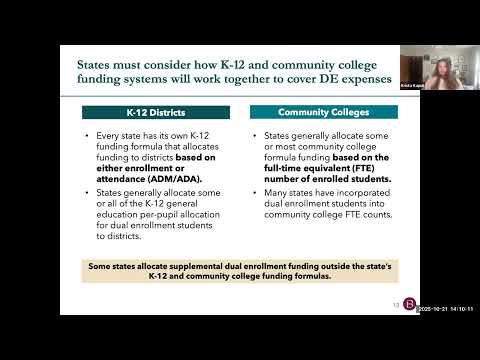
Policy themes and recommendations: Across the case studies, Caput said supportive approaches include (1) states covering tuition and non‑tuition expenses for targeted or all students; (2) allocating the full per‑pupil amount through K–12 formulas for dual‑enrolled students and, where appropriate, equivalent funding to community colleges; (3) state reimbursement or flat credit rates for community‑college tuition; (4) clear MOUs or minimum partnership requirements; (5) state goals and strong data reporting to surface equity gaps; (6) investments in instructor credentialing and college advising; and (7) sustainable funding embedded in state formulas rather than short grants.
Challenges and evidence limits: Caput flagged persistent instructor capacity shortages—"there's just not enough teachers who meet the minimum requirements to teach dual enrollment"—and noted data limitations: states often do not fully disaggregate participation by race or disability, and some data are locked in nonmachine‑readable formats. She also said more rigorous longitudinal research is needed to link funding changes to long‑term degree and labor outcomes.
Q&A highlights and practical advice: In response to audience questions, Caput recommended that states inventory existing programs and funding interactions, map how dual‑enrolled students are counted in K–12 and community‑college formulas, pull program‑level data, and then align funding reforms with state goals and capacity. She suggested looking to other states for models—Idaho for program consolidation, California for statutory accountability metrics, Minnesota for convening a statewide visioning process—and recommended continued audits and business engagement when aligning coursework to workforce needs.
Next steps: The Bellwether report includes state case studies and an executive summary available through the MEC event materials; Caput offered to share additional data about four‑year institutions and pointed attendees to the Community College Research Center at Columbia for further analysis. The webinar closed with links to the recording, posted slide deck and a post‑event survey.