Get Full Government Meeting Transcripts, Videos, & Alerts Forever!
Get email alerts on the Postsecondary Value And Roi topic
No spam. Unsubscribe anytime.
States push to prove higher-education 'value' through ROI, data and policy levers
Summary
Education Strategy Group and Midwestern Higher Education Compact speakers described a national 'great value shift' in higher education: states are moving from measuring attainment to measuring return on investment, using public data, program review and incentive funding to align programs with labor-market outcomes.
Education-policy experts told a Midwestern Higher Education Compact webinar that states are shifting from assuming higher-education value to proving it through measurable return-on-investment metrics and aligned policy actions.
Dr. Kenyatta Lovett of Education Strategy Group said the field is in a "great value shift" and urged leaders to coalesce around three pivots: shared leadership across higher education and workforce actors, adoption of meaningful measures, and alignment of policy actions to drive postsecondary value. "Value must be proved and not assumed," Lovett said.
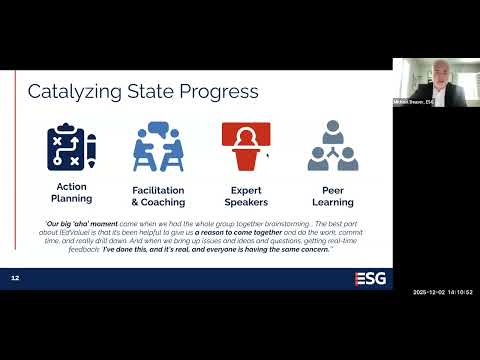
Dr. Michael Duzer, also of Education Strategy Group, outlined ESG’s approach to helping states: action planning, facilitation and coaching, expert speakers, and peer learning. He described three types of credentials states are identifying: "credentials of value" (high economic returns), "credentials of economic necessity" (jobs society needs, like teachers or social workers), and "credentials of mobility" (stackable entry credentials that support upward movement in the labor market).
Duzer emphasized policy levers states are using to shape supply and demand: transparency and public reporting, program approval and review, formula funding adjustments and institutional strategy. He cited Louisiana’s use of academic program review and labor-market data to align new program approvals with regional strategic needs and Tennessee’s plan to revise outcomes-based funding to include a workforce investment premium tied to wage outcomes and projected job growth.
Panelists cautioned that quantitative measures are only one part of a broader conversation. Lovett and Duzer said states should look beyond short-term wage outcomes to wealth accumulation and equity considerations, and should engage faculty and institution leaders in co-design to avoid misinterpretation or resistance from campuses.
Speakers urged states to rely on publicly available, verifiable data sources (for example, Bureau of Labor Statistics and American Community Survey) to build trust. "Use publicly available trusted data sources because that's often the criticism you'll get," Dr. Amy Giske of the Iowa Department of Education said.
The webinar highlighted that while states across the political spectrum are confronting similar problems—declining enrollment, affordability, student debt, and workforce misalignment—how they define and act on "value" varies with governance structures and local workforce needs. Panelists recommended starting with tested models, vetting data publicly, engaging stakeholders early, and scaling policy levers gradually.
The Midwestern Higher Education Compact plans to continue work on value and mobility in the coming year; slides and the webinar recording will be posted and attendees were invited to provide feedback via a survey.