Get Full Government Meeting Transcripts, Videos, & Alerts Forever!
Get email alerts on the Reconciliation Higher Ed topic
No spam. Unsubscribe anytime.
Reconciliation package reshapes student-aid rules and research funding, speaker warns
Summary
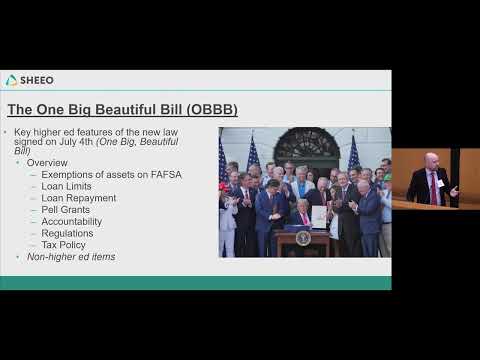
Tom Harnish outlined how the FY26 reconciliation package would change FAFSA asset tests, cap graduate and Parent PLUS borrowing, consolidate repayment plans, create a workforce Pell program with state approval, impose new accountability thresholds, cut Medicaid/SNAP funding with downstream effects, and cap indirect research-cost recovery at 15%, all of which could materially affect institutional budgets and student access.
Tom Harnish, vice president for government relations at the State Higher Education Executive Officers (SHEEO), told Midwestern Higher Education Compact attendees that the FY26 reconciliation package — described as a tax-and-spending measure — contains several provisions that will reshape institutional finance and student access.
FAFSA and asset exemptions: Harnish said the bill restores an exemption on the FAFSA for family farms and small businesses (firms with 100 or fewer employees) and that the exemption is reflected in the new FAFSA; he said the change takes effect in February 2026 and should help students in farm states.
Graduate borrowing and Parent PLUS: He described a major restructuring of graduate borrowing into two categories: a "master's" bucket (roughly $20,500 annually, $100,000 aggregate) and a "professional" bucket (roughly $50,000 annually, $200,000 aggregate). He said Grad PLUS will be phased out for new borrowers starting in 2026. On Parent PLUS, Harnish said borrowing would be capped at $20,000 per year with a lifetime-per-child cap of $65,000.
Repayment simplification and RAP: Harnish said Congress plans to consolidate the many existing repayment programs into a standard repayment option and an income-based Repayment Assistance Program (RAP) beginning in 2026; current borrowers will need to transition to the new framework.
Pell and workforce Pell: Harnish warned that the bill could move Pell away from a strict "first-dollar" model. He described a new workforce Pell program that requires state governors to work with workforce boards to approve accredited, stackable programs (8–15 weeks, 150–599 clock hours) that demonstrate completion and job-placement outcomes; workforce Pell pilots would start July 1, 2026 with broader adoption expected in early 2027.
Accountability, Medicaid and SNAP: Harnish summarized a new accountability regime that compares completers' earnings to state medians and cited a CBO estimate of $7,777,000,000 in savings over 10 years for the accountability provisions. He also warned that Medicaid changes in the package could total roughly $1,000,000,000,000 over 10 years (Kaiser Family Foundation estimate) and that SNAP administrative-cost changes could have first- and second-order effects on campuses and state budgets.
Research and institutions: Harnish said the package would cap indirect-cost recovery for federal research grants at 15% across agencies (NSF, NIH, DOD, DOE), down from common rates near 30%, and that research universities had already filed lawsuits. He also described a proposed institutional "compact" that would condition federal advantages on provisions such as admissions-equality language, limits on foreign-student shares, a five-year tuition freeze and requirements on grading transparency; he said the compact raised legal questions about how it would interact with statutory program rules.
Regulatory and legal notes: Harnish said negotiated rulemaking committees (RISE for student loans; an "AHEAD" committee for workforce Pell) are working to operationalize the bill and that compressed rulemaking timelines mean new rules must be ready by about June 1 for a July 1, 2026 effective date. He noted litigation is already under way on MSIs and that the Department of Justice's web-accessibility rule creates ADA compliance deadlines for campus web/mobile content (April 26, 2026 for institutions of 50,000+ users; 2027 for smaller institutions).
Questions from the audience covered the compact's status and international-student caps; Harnish said the compact initially launched with nine institutions, saw little uptake, and has since been opened to all institutions with a small number expressing interest (New College of Florida named). He urged caution about legal compatibility and said departments and courts may determine how many provisions can be operationalized.