Get Full Government Meeting Transcripts, Videos, & Alerts Forever!
Get email alerts on the Workforce Development topic
No spam. Unsubscribe anytime.
Ohio Lt. Gov. Jim Tressel urges Midwest colleges to align programs with regional workforce needs
Summary
At the Midwestern Higher Education Compact conference in Cleveland, Lt. Gov. Jim Tressel urged higher-education leaders to use historical review, contemporary data and forward-looking planning to produce a workforce for regional employers and highlighted a statewide youth fitness pilot that drew broad participation.
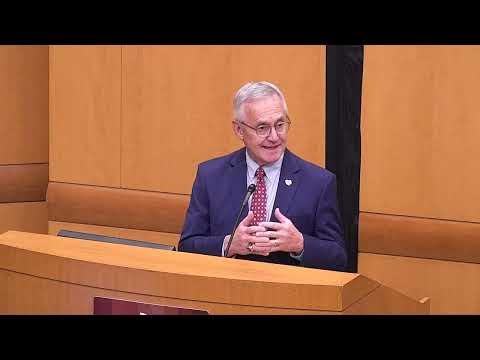
Jim Tressel, lieutenant governor of Ohio, used a keynote at the Midwestern Higher Education Compact conference in Cleveland to press colleges and universities in the region to align academic programs with current and projected labor-market needs.
Tressel opened by describing a governor-directed youth fitness challenge pilot for grades 4–8 that he helped assemble quickly. "We got a response from 700 high schools, 183,000 kids," he said, describing instructional videos, assemblies and recognition events used to engage students.
The lieutenant governor framed that effort as an example of rapid, cross-agency work and pivoted to workforce concerns. He cited estimates of an 18,000-worker shortfall for welders in Ohio and a 45,000 shortfall nationally, and recounted an employer conversation — naming Sherwin-Williams — that underscored demand for Ph.D.-level chemists alongside skilled trades. "We have to produce every single part of the workforce and not overcorrect in one direction or the other," he said.
Tressel also presented labor-market data to make the case to policymakers and college leaders. He said roughly three-quarters of job postings that pay about $50,000 or more list a two- or four-year degree among preferred qualifications and that approximately 68% list a four-year degree as the requirement, arguing that public perceptions that fewer people need college are misplaced.
Quoting an article by Robert Greenleaf, Tressel urged higher-education leaders to adopt a three-part practice for public service: be "great historians" who study how past decisions produced current results; embrace contemporary analytics to understand changing demographics and labor demand; and be "great prophets" who plan so future historians will judge today’s choices as wise. He used coaching analogies to emphasize learning from past performance and applying present data to plan for the future.
Tressel framed his remarks as pragmatic rather than prescriptive: he described his 18-month assignment from the governor to focus on education and workforce, and he repeatedly called for cross-sector conversations among colleges, K–12 systems, industry and state agencies to ensure regionally relevant talent pipelines.
He closed by thanking conference organizers and leaders and noting the conference’s Cleveland setting, urging continued collaboration across higher education, business and government.
The speech did not include formal proposals or votes; Tressel presented examples, data and a policy framework for discussion and partnership.