Get Full Government Meeting Transcripts, Videos, & Alerts Forever!
Get email alerts on the State Legislative Trends topic
No spam. Unsubscribe anytime.
Midwest legislatures face property‑tax battles, AI rules and data‑center energy questions, CSG Midwest director says
Summary
Laura Tamaka, director of the CSG Midwest office, told the Midwestern Legislative Conference that property‑tax reform dominated 2025 sessions while lawmakers also moved on labor leave, education changes, AI safeguards and data‑center siting and energy concerns going into 2026.
Laura Tamaka, director of the CSG Midwest office, told attendees at the Midwestern Legislative Conference that statehouses across the region entered 2026 with “some mixed signals” in the national economy and that property‑tax reform was the dominant topic of this year’s sessions.
“Property taxes dominated debates in most of our states,” Tamaka said, citing a wave of bills and a range of enacted changes. She gave examples including caps on property‑tax increases in Ohio, North Dakota and South Dakota and expansions to homestead or veterans’ tax credits in North Dakota and Indiana. On tax policy more broadly, she noted Missouri became the first state to allow a 100% capital‑gains deduction and that other states both increased and reduced different taxes as part of package reforms.
Tamaka placed the tax fights in a broader fiscal context: she said pandemic‑era surpluses were winding down, revenue growth was slowing and states were planning more cautiously for fiscal 2026. “Revenues are expected to grow about 1% in 2026,” she said, compared with roughly a 2.4% increase in 2025, and several states asked agencies to submit flat or reduced budgets.
Beyond taxes, Tamaka highlighted major policy themes of 2025. On labor, she said many states expanded leave protections — for example, parental leave for state employees in Iowa and neonatal intensive‑care leave in Illinois — while some states narrowed coverage or repealed measures previously passed by voters. She cited Ohio’s so‑called Mini WARN Act requiring at least 60 days’ notice for employers planning large layoffs.
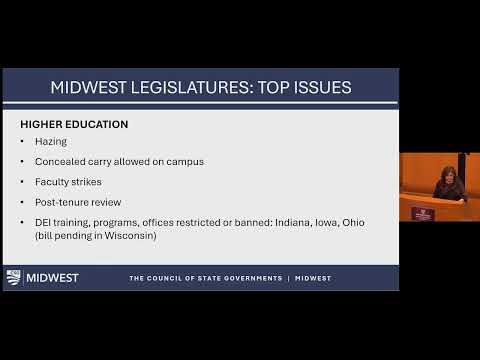
Education measures included a mix of curriculum changes and school‑policy moves. Tamaka said Iowa enacted a requirement that high‑school students pass a U.S. civics test and Kansas rolled out a science‑of‑reading curriculum requirement, while Indiana advanced a universal private‑school voucher program and several states debated restrictions on classroom cell‑phone use.
On technology and elections, Tamaka said states moved quickly to address artificial intelligence and election integrity: North Dakota criminalized misleading campaign ads, South Dakota banned AI deepfakes intended to influence elections, and multiple states passed child‑safety and age‑verification measures for online services.
Tamaka also singled out data‑center growth and its infrastructure implications. She reported a quick count of “around 300 data centers throughout the Midwest,” warning that their energy and water use raises new regulatory and grid‑capacity questions. Tamaka used one anecdote to underscore the scale: she described an example of a Microsoft data center with exceptionally high energy use, presented as illustrative rather than independently verified.
Energy policy was another area to watch. Tamaka said Illinois recently lifted a long moratorium on large power‑plant construction and that Michigan recommissioned a reactor, developments that have renewed interest in nuclear power — including small modular reactors — as policymakers weigh how to supply growing electricity demand.
Tamaka closed by inviting attendees to upcoming CSG Midwest webinars on school safety, Great Lakes water use and data centers, property‑tax policy and victim assistance, and by noting the organization’s national meeting in Chicago and its Midwestern Legislative Conference in Saint Paul.
The presentation did not include formal votes or motions; Tamaka repeatedly described some numeric claims (for example, counts of proposed bills in Illinois) as read from external sources and not independently verified.