Get Full Government Meeting Transcripts, Videos, & Alerts Forever!
Get email alerts on the Risk Management topic
No spam. Unsubscribe anytime.
Tollway details insurance, cyber coverage and safety gains; ROSIP expands contractor access
Summary
Risk management officials outlined the Tollway's insurance layers — including $10 million cyber aggregate and $200 million property limit — described the ROSIP program to help small contractors meet insurance requirements, and highlighted a decline in OSHA incident rate and workers' compensation reserves.
Risk management staff presented an overview of the Illinois Tollway's insurance programs, cyber protections, contractor insurance initiatives and safety outcomes on Jan. 21.
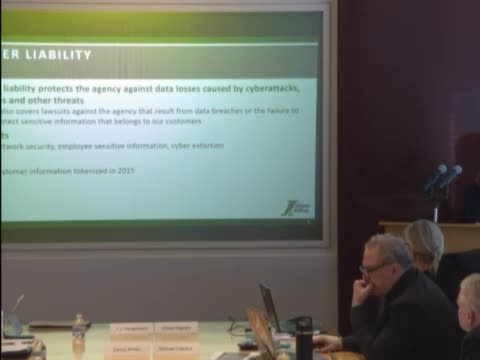
The presenter said the agency tokenized customer data in 2015 and currently maintains cyber liability insurance with Travelers with aggregate limits of $10,000,000; the program is under review with a new insurance consultant to identify coverage gaps and benchmark peer practices. Property insurance provides a $200,000,000 loss limit (a $100 deductible) and the general liability program includes a primary Lexington Insurance layer of $5,000,000 plus excess layers totaling roughly $145,000,000, subject to a $1,000,000 deductible.
To broaden contractor participation, the Tollway runs a rolling owner‑controlled insurance program (ROCIP/ROSIP) that helps small and diverse firms meet coverage limits and compete for prime contracts; officials cited participation in the second term including 13 unique prime contractors and 51 unique subcontractors. An owner‑controlled insurance program (OSEP) was also noted for a portion of the Illinois 490 project requiring railroad access.
On employee and operational safety, staff reviewed the self‑insured workers' compensation program (in place since 1988), said an independent actuary sets reserve levels, and reported that the OSHA incident rate declined from 10.72 in 2016 to 3.72 in 2024. Staff noted a 2025–26 funding level figure for workers' compensation reserves that was presented during the meeting.