Get Full Government Meeting Transcripts, Videos, & Alerts Forever!
Get email alerts on the Continuing Education topic
No spam. Unsubscribe anytime.
Optometry practice-and-education committee approves multiple CE courses, defers three pending disclosures
Summary
At its Feb. 13 teleconference, the Practice and Education Committee of the California State Board of Optometry approved a block of continuing-education (CE) courses, changed one course category from ocular disease to general, and directed staff to obtain missing financial disclosures and topic breakdowns for three courses before issuing certificates.
At a Feb. 13 teleconference, the Practice and Education Committee of the California State Board of Optometry approved a package of continuing-education courses and sent three items back to staff for follow-up.
The committee chair called the meeting to order, confirmed a quorum and moved to approve draft minutes from the Nov. 21, 2025 meeting before turning to agenda item 4, continuing education courses. After discussing several individual applications, the committee approved a block of courses by roll call. Doctor Stacy Bragg, committee chair, Doctor Joe Pruett, and Doctor Lillian Wong voted to approve the motion.
Why it matters: CE approvals determine which educational activities count toward license renewal for optometrists and when providers may issue certificates to attendees. During the meeting staff and committee members noted that certificates cannot be issued until the board approves a course and that missing paperwork or unclear course categories can delay credit for attendees.
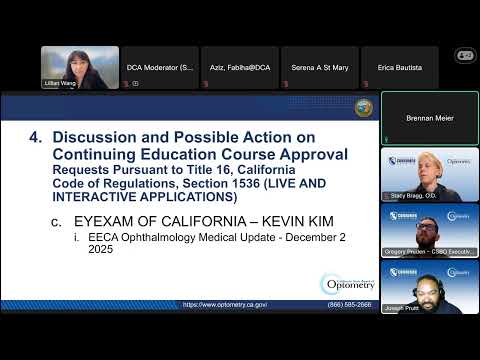
The committee discussed four courses in detail. For item 4c (CI) staff reported that the packet lacked a required financial-disclosure form and that the provider had not yet been able to supply the paperwork; staff said they were communicating with the provider. The committee directed staff to withhold approval of 4c until the financial disclosure is received and confirmed. As the Webex moderator said during the meeting, “there are no requests for public comment at this time.”
On item 4d (IOL technology), Doctor Joe Pruett said the course focuses on lens technology rather than disease treatment and asked that the category be changed from ocular disease to general. Committee members agreed and subsequently voted to approve 4d with the category change; the committee recorded aye votes from Bragg, Pruett and Wong.
Committee members also raised concerns about item 4k (Harvard Eye Associates) and item 4n, which appear to mix glaucoma content with cataract/IOL or dry-eye topics. The committee asked staff to contact Harvard Eye Associates and other providers to obtain a percentage breakdown of how much of each presentation is devoted to glaucoma versus cataract/IOL or dry eye. Staff were instructed that if a course is roughly split (about 50/50) between two topics, it should be reclassified as ocular disease rather than a single-topic credit.
The committee approved the remainder of the listed courses as a block, excluding 4c, 4k and 4n pending follow-up. Staff (Greg) was given explicit directions to obtain the missing financial disclosure for 4c, notify providers of any category changes, and confirm topic breakdowns with Harvard Eye Associates and others so certificates can be issued after formal approval.
The committee also asked staff to research additional CE-category clarification options used by other jurisdictions (a member referenced New Jersey) for consideration at a future meeting. The teleconference adjourned after the committee summarized outcomes and next steps.