
Producer responsibility group says reimbursements, end‑market investments and reuse will be central once CAA plan is approved
Get AI-powered insights, summaries, and transcripts
Subscribe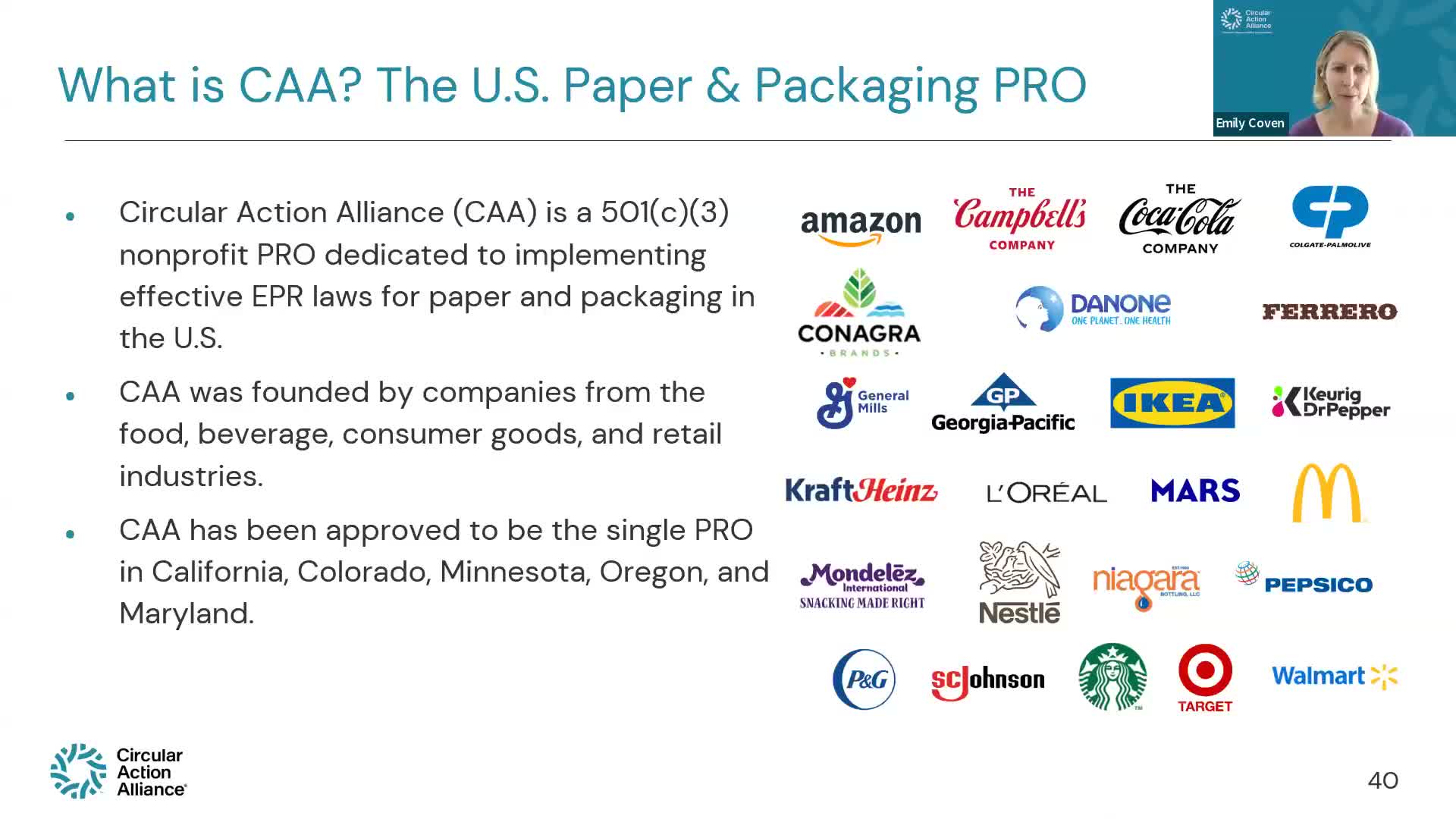
Summary
CAA and advisory‑board members told webinar attendees the producer responsibility organization will collect fees, reimburse jurisdictions retroactively to 2023, invest in end‑markets and reuse/refill programs, and run education and outreach once the program plan is approved.
The Circular Action Alliance (CAA), the producer responsibility organization (PRO) formed by producers to implement SB 54, told a statewide webinar that it will both collect producer fees and direct investments to build recycling infrastructure, cover transportation to end markets and reimburse local jurisdictions for implementation costs going back to Jan. 1, 2023.
"We are the producer responsibility organization implementing SB 54," said Emily Kovan, CAA’s California executive director, who described a two‑fold approach: ecomodulation of fees to incent product redesign and using collected fees to fund infrastructure, education and operations. Kovan said CAA will submit a comprehensive program plan to the SB 54 advisory board on June 15 and that the plan will be public once submitted.
CAA officials said the reimbursement framework is intended to cover both capital investments (such as optical sorters) and ongoing operating costs, including labor, public education and administrative expenses. Kovan specified that eligible applicants include local jurisdictions, service providers (MRFs), JPAs, tribal governments and school districts, and that CAA will host an online portal for applications and provide regional specialists to help applicants prepare documentation.
John Kennedy and Emily Kovan emphasized that reimbursement eligibility can be retroactive to Jan. 1, 2023, so jurisdictions that have already invested in preparation may apply for reimbursement. Kovan cautioned that CAA cannot disburse funds until the program plan is approved, but applications may be prepared and submitted once the portal opens.
CAA and advisory‑board chair Timothy Burrows highlighted the emphasis on responsible end markets and reuse. Burrows said the statute creates a unique Plastic Pollution Mitigation Fund totaling $5 billion (paid as $500 million per year over 10 years starting in 2027) to be appropriated through the state budget with 50% of funds targeting disadvantaged communities and environmental justice goals.
Panelists acknowledged major end‑market gaps for several materials (PET thermoforms, film/flex, poly‑coated paper, cartons and some aluminum) and said CAA will work nationally to harmonize standards for responsible end markets and pursue investments to develop processing capacity. CAA also plans an RFI and pilot work to support reuse and refill — targeting a 10% conversion of single‑use packaging to reuse/refill models by 2032, with priority for closed‑loop settings such as stadiums, schools and corporate cafeterias.
What local governments should do now: panelists urged jurisdictions to catalog past and projected implementation costs, talk with haulers and MRFs about acceptability lists, consider exemption petitions where collection is impracticable, and engage with the SB 54 advisory board and CAA plan review to shape reimbursement rules and priorities.