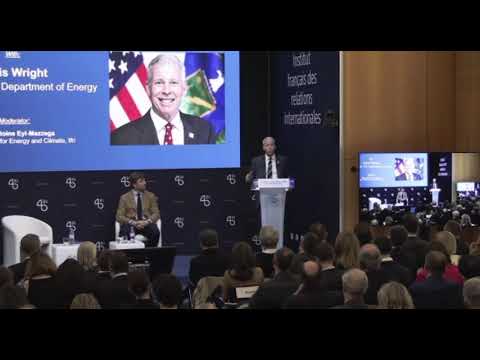
Secretary warns U.S. grid needs transmission and firm capacity; says batteries provide minutes, not days, of storage
Loading...
Summary
In Paris, Secretary Wright said U.S. electricity generation has lagged even as fossil fuel production rose, called battery storage insufficient for long-duration needs ("3 or 4 minutes" of storage) and urged investment in transmission reconductoring and other grid projects.
Secretary Wright told a Paris audience that, despite large increases in U.S. oil and gas production over two decades, the country "barely produce[s] more electricity today than we did 20 years ago," and he urged faster expansion and better use of transmission capacity.
He described electricity's operational constraints: delivering firm power at peak demand matters more than total 'electrons on the grid' at any moment. Citing a recent cold spell, Wright noted large natural‑gas draws to keep homes warm and said wind, solar and batteries were limited at peak moments in some regions: "At the very peak demand time in New England, wind, solar, and batteries were 2% of New England electricity."
Wright also said the total of U.S. batteries—"including in all the electric cars"—can store grid output for only "3 or 4 minutes," stressing that batteries are more useful for shaving the highest peaks than for long‑duration energy storage.
On transmission, Wright supported reconductoring existing lines to increase capacity within existing rights-of-way and described transmission buildout as politically and technically slow: "It's so easy to stop something. It's so hard to build something."
He described a pragmatic approach—build lines that debottleneck regions, focus on cost‑effective projects and avoid subsidizing low‑value remote generation—without endorsing a specific national transmission plan.
Next steps: Wright highlighted policy priorities—permitting reform, targeted transmission investment and measures to ensure firm generating capacity during peak demand—but offered no specific federal funding commitments.