Get Full Government Meeting Transcripts, Videos, & Alerts Forever!
Get email alerts on the Regional Investment Implementation R2 topic
No spam. Unsubscribe anytime.
GoBiz opens Round 2 of Regional Investment Initiative with $45 million for implementation grants
Summary
GoBiz and partners outlined a two‑phase competition to award roughly $45 million in implementation grants, set Notices of Intent due 11/05/2025 and full applications due 01/16/2026, and clarified rules on cluster size, for‑profit participation, procurement and project readiness during a live office hour.
The Governor’s Office of Business and Economic Development (GoBiz) detailed the Regional Investment Initiative implementation round 2 in a public office hour, announcing roughly $45,000,000 in state implementation grant funding and a two‑phase application process that starts with a Notice of Intent (NOI) and moves to pre‑applications and invited full applications.
Derek, senior advisor for economic policy at GoBiz, said the program will again select regional coalitions and project clusters that advance a single tradable sector, then fund competitive individual projects within those clusters. "GoBiz, in partnership with EDD, and the Jobs Council, which includes the labor agency is making, available approximately $45,000,000 in grant funding within the implementation phase round 2," he said. Key dates include an NOI due by 5 p.m. Pacific on Nov. 5, 2025; pre‑applications due Dec. 3, 2025; and invited full applications due by email to regionalinvestment@gobiz.ca.gov by 5 p.m. Pacific on Jan. 16, 2026.
Why it matters: the awards are intended to invest in projects that scale sector growth across regions; GoBiz emphasized geographic equity, benefits to disinvested communities and the capacity of lead organizations as additional scoring considerations. Awards are anticipated to have a 24‑month performance period and an expected start date in August 2026. "The minimum award amount for a single project is $500,000 and there is no maximum award," Derek said, while noting that top scoring projects may be adjusted to fit the available roughly $45 million total.
Eligibility and cluster rules: GoBiz reiterated that each cluster must advance a single tradable sector identified in the state's economic blueprint and must include between three and eight aligned projects; fewer than three or more than eight projects renders a cluster ineligible. Eligible sectors were described as those in the accelerate or bet buckets — examples listed include aerospace and defense, life sciences, onshore wind, ag tech, carbon management, the bioeconomy and artificial intelligence — while creative economy, transport and logistics, tourism/outdoor recreation, and food manufacturing were noted as ineligible under this round because they sit in the strengthened bucket.
Private‑sector participation and procurement: GoBiz clarified repeated attendee questions about for‑profit involvement. For‑profit companies may participate in clusters as contractors or industry partners (for example, providing workforce placements or participating in curriculum development), but GoBiz will not make pass‑through grants that give state funds directly to a business via a nonprofit or education provider. "We are not doing pass through grants through a nonprofit or an education provider to a specific business," Derek said. Grantees that plan to procure services from for‑profit firms must follow formal procurement processes; applicants may identify intended contractors in applications but still must meet procurement and sole‑source justification rules if applicable.
Readiness and permissible activities: The program is targeted at "ready to go" projects. Derek said projects needing planning, environmental review, or architectural design are not eligible for this implementation pool; applicants should be able to show plans and permitting paths when permits are not yet in hand, but projects that require substantial predevelopment work should not expect to qualify. GoBiz will accept some flexibility on permits provided applicants explain how they will obtain them quickly before the anticipated August 2026 start date.
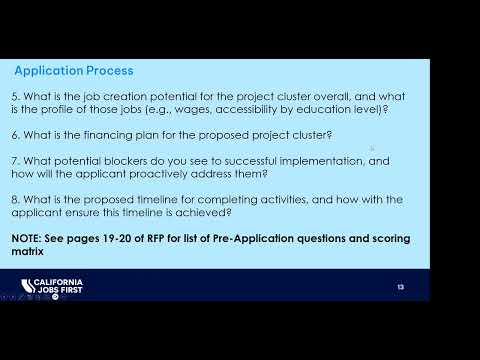
Application process details: Phase 1 begins with a single NOI per lead entity (one NOI per review cycle), and organizations that submit an NOI are eligible to submit the phase 1 pre‑application (limited to short, ≤300‑word answers across eight questions). Finalists from the pre‑application round will be invited to submit full applications; the scoring window for full applications is scheduled for Jan. 26–Feb. 23, with finalist notifications by March 2 and an investment summit in mid‑March. GoBiz plans to post NOIs to its website after the Nov. 5 deadline to encourage coalition building.
Other clarifications from the live Q&A: education institutions are eligible to lead clusters; community development financial institutions and small business development centers can participate and provide financing or technical assistance; childcare programs can be included as anchor projects if clearly tied to advancing the cluster's tradable sector; and letters of concurrence from regional conveners are required at the full application phase for projects supporting workers in a given region.
What happens next: GoBiz said it will post the webinar recording, RFP, web form and an errata document with date changes to the GoBiz website (the NOI web form was scheduled to go live Oct. 1). Questions submitted during the NOI, pre‑app and full app windows will be published on a public FAQ on the website per the published deadlines.