Get Full Government Meeting Transcripts, Videos, & Alerts Forever!
Get email alerts on the Infrastructure Financing topic
No spam. Unsubscribe anytime.
IBank outlines infrastructure loan terms, bond options and application steps to speed local projects
Summary
At a California Jobs First webinar, IBank representatives detailed the Infrastructure State Revolving Fund (ISERF) loan program (loans $1M–$65M, terms up to 30 years, subsidies up to 50 basis points) and IBank’s conduit bond services, including examples of recent projects and timelines for application and closing.
At a California Jobs First webinar, Lena Mueller of the California Infrastructure and Economic Development Bank (IBank) and bond finance manager Fariba Khouri described state financing tools for infrastructure projects, including the ISERF revolving loan program and IBank’s conduit bond issuance services.
Mueller said ISERF is a tax‑exempt revolving loan fund that finances infrastructure for eligible public borrowers and sponsored entities. "We are the state of California's only general purpose financing authority," she said, and described ISERF eligibility as "any subdivision of the state or local government, including departments, agencies, commissions," with a stated minimum loan of $1,000,000 and a maximum of $65,000,000.
The ISERF underwriting approach depends on the project’s repayment source. Mueller described two typical structures: lease‑leaseback financings analyzed against a jurisdiction’s general fund and enterprise‑fund financings backed by system revenues for utilities. She emphasized that ISERF funds are tax‑exempt and therefore cannot include private activity absent alternative financing or a taxable loan component.
IBank presented example interest rates current at the time of the webinar: a 30‑year unrated credit at about 5.22% and an A‑rated credit at about 4.64%; for a 15‑year term, examples were 4.42% (unrated) and 3.64% (rated). Mueller said borrowers may qualify for up to 50 basis points of subsidy—25 bps for environmental benefits and 25 bps for community‑based subsidies—reducing the all‑in rate. She also noted a typical 15‑basis‑point servicing fee is included in the stated rates.
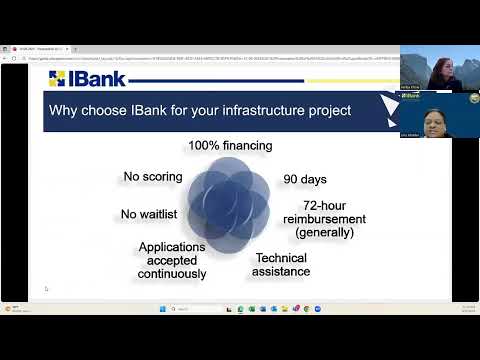
On process and timing, Mueller said a preliminary review typically takes one to two months (standard ~6 weeks) and the whole cycle from initial contact to funds can take about four to six months, with the ability to expedite cases. ISERF requires an executed borrower reimbursement resolution before IBank board consideration; after board approval, borrowers have six months to execute financing agreements. Disbursements are made from a trust account on invoice submission, and borrowers begin principal and interest payments at loan closing.
Khouri described IBank’s role on the bond side as a conduit issuer that facilitates tax‑exempt financing for qualified projects. "As conduit issuer, we don't do the underwriting of the bond transactions, but we work closely with different financial institutions, underwriters and lenders," she said, noting IBank can issue bonds for a broad set of public‑benefit projects and that bond terms can extend up to 50 years where the useful life of project assets supports that maturity.
Khouri reviewed program constraints that affect tax status and scale, including federal IRS ceilings on certain industrial development bonds and the need for volume cap allocation from the California Debt Limit Allocation Committee (CDLAC) for some private‑activity categories. She highlighted recent IBank cases including solid‑waste, streetscape, fire station, solar, museum, and wastewater projects.
A participant asked whether ISERF loans remain competitive during periods of higher market rates. Mueller answered that ISERF can refinance prior debt only when the new financing includes added infrastructure, and Khouri added that refundings are sometimes pursued to change transactional provisions beyond rate savings.
IBank presenters shared contact information and said slides and recordings will be posted after the webinar. The discussion concluded with an offer of technical assistance and loan officers assigned to each loan to guide applicants through underwriting and closing.
The webinar moved next to the State Treasurer's Office and CPCFA presentations; no formal votes or policy actions were taken during IBank’s segment.