Caltrans presents rebalance of proposed 2026 SHOP, cites storm costs and capacity constraints
Loading...
Summary
Caltrans told the California Transportation Commission that the draft 2026 State Highway Operation and Protection Program was rebalanced because allocation capacity is limited and recent storm/emergency costs exceeded $1 billion; the department emphasized asset preservation and an interactive project dashboard. The commission will consider adoption in March.
California Transportation Commissioner Bob Tiffany opened a Northern California hearing on the proposed 2026 State Highway Operation and Protection Program (SHOP) and emphasized the program’s role in the state’s 'fix it first' strategy. Acting state asset management engineer Diana Campbell told the California Transportation Commission that Caltrans rebalanced the draft SHOP because allocation capacity cannot fund all candidate projects and because recent storms and emergencies have driven more than $1,000,000,000 in costs.
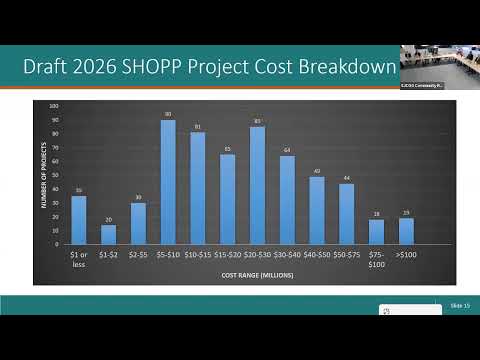
Campbell summarized the draft portfolio as nearly 600 projects, with Caltrans presenting a portfolio figure during the hearing of approximately $17,000,000,000 across four years and noting about 521 carryover projects. She said 19 projects in the portfolio exceed $100,000,000 and that those larger projects require more careful management of design, environmental permitting and right‑of‑way to limit cost and schedule risk. 'The allocation capacity available is just simply insufficient to allocate to all projects that could come forward,' Campbell said, explaining the rationale for deferrals and rebalancing.
The department said core asset preservation—pavement, bridges, culverts, transportation management systems and safety—accounts for roughly 75% of SHOP funding, supporting SB 1 performance commitments. Caltrans staff cited targeted outputs in the presentation, including repairing about 5,500 lane miles of pavement and addressing roughly 4,700,000 square feet of bridge elements over the SHOP cycle. Campbell also said that multimodal elements remain a priority where feasible: about 45% of projects include some bicycle, pedestrian or transit feature, although roughly 28% of projects cannot feasibly add such elements (for example, interstates where bikes and pedestrians are not permitted).
To increase transparency, Caltrans highlighted an interactive, GIS‑enabled project dashboard (projectbook.dot.ca.gov) that displays planned projects over a 10‑year horizon and is updated quarterly. John Pray, the commission’s assistant chief engineer, reviewed statutory milestones and said Caltrans submitted the draft SHOP and stakeholder comments in late January; the commission will review the draft and consider adoption at its March meeting, with a possible submittal to the governor and legislature by April 1 if adopted.
No action was taken at the informational hearing. The presentation and subsequent public comments will be part of the commission’s record as it completes its review ahead of the March adoption vote.