Get Full Government Meeting Transcripts, Videos, & Alerts Forever!
Get email alerts on the Apprenticeship Funding topic
No spam. Unsubscribe anytime.
Employment Training Panel approves roughly $22.7 million for 73 apprenticeship projects, amends workforce literacy pilot
Summary
The Employment Training Panel voted to fund a slate of apprenticeship contracts totaling about $22.7 million for 73 projects and approved staff-recommended changes to the workforce literacy pilot, including a contract extension to June 30, 2026, broader curriculum flexibility and a lower full-time-hours threshold to expand eligibility.
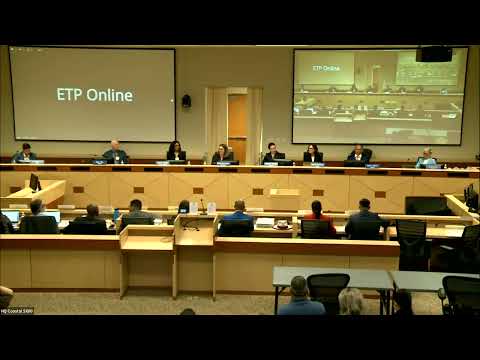
The Employment Training Panel on Friday approved funding for a large set of apprenticeship proposals and adopted changes to the agency's workforce literacy pilot.
In remarks introducing the panel packet, Jaime Gutierrez, chief deputy director, said, "In regards to today's funding, today's panel meeting is for approximately $22,700,000," and described a pipeline of 226 applications valued at about $125,800,000. Staff told the panel the day’s items represented 73 projects under consideration.
Panel members voted, by roll call, to approve grouped sets of tabbed proposals across multiple trades. The chair confirmed that the initial omnibus motion to authorize tabs 1–22 (with tab 4 and tab 10 removed for separate review) passed by unanimous 'Aye' votes from the members present. Subsequent grouped motions funded the remaining tabbed proposals considered that day across electrical, finishing, carpentry, sheet-metal, ironworking, plumbing and other trade apprenticeships; several members recused themselves from specific tab votes as noted on the record.
Willie Atkinson, assessment programs manager, led the apprenticeship presentation and introduced apprentices who described the programs' impact in personal terms. Apprentice Cayman Peterson told the panel, "Signing up for ABC is the best thing I've ever done," crediting an electrical apprenticeship with providing steady work and helping him start a family. Jennifer Clickenbeard, a recent surveying apprentice, described becoming a crew chief on a high-speed-rail project after five years in apprenticeship training. Several apprentices cited the Erika (childcare) grant as important support for participating in coursework and meeting training commitments.
Panel members also heard from training directors about recruitment and outreach. Lou Snyder of the Southern California Laborers described female-focused boot camps and said his program has 62 women enrolled. Kevin Johnson (San Diego Electrical) reported preapprenticeship cohorts with growing female participation and a targeted veteran-entry program that gave direct access to apprenticeship for transitioning service members. Ben Rivera (Bay Area Sheet Metal) described a year of aggressive outreach with hundreds of events recorded and noted retention remains the major challenge after recruitment.
On policy, the panel adopted staff recommendations to amend the workforce literacy pilot. Ilya, the literacy program lead, presented four changes: extend contract terms for literacy pilot programs to end on June 30, 2026; remove the requirement that a significant portion of literacy training be English-only to allow other literacy modalities (including digital literacy); redefine full-time employment for the pilot from 35 hours to 28 hours per week to broaden eligibility; and align trainer–trainee ratios by raising the new-hire ratio to 1:20 to match incumbent training. The panel took public comment in support of the extension; an online commenter representing the National Immigration Forum said the additional time would help first-time ETP contractors finish implementation and reach employer partners. The panel approved the workforce-literacy amendments by unanimous roll-call vote.
During the meeting staff and members discussed implementation logistics and noted some panel packet performance numbers lagged behind live administrative systems; staff explained a production delay between report printing and the live CalE-Force data. Several panel members asked contractors to prioritize administrative uploads so training hours and performance metrics align with current activity.
The chair closed the meeting after a brief public-comment period and a roll-call vote to adjourn; the meeting ended at 11:37 a.m. The panel indicated staff will continue reporting on SB 1321 implementation and on apprenticeship and literacy program performance in upcoming public meetings.