Get Full Government Meeting Transcripts, Videos, & Alerts Forever!
Get email alerts on the Hrtp Healthcare Grant topic
No spam. Unsubscribe anytime.
CWDB opens $28.5 million HRTP health care grant; applications due Nov. 12
Summary
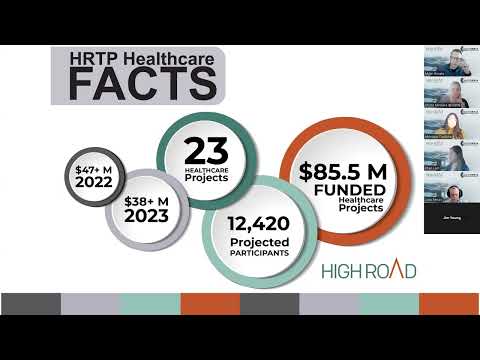
The California Workforce Development Board announced a $28.5 million High Road Training Partnerships (HRTP) health care grant, prioritizing projects that create quality jobs, serve communities with the greatest need, and include specified partner types. Applications must be submitted via Cal eGrants by Nov. 12 at 5 p.m.
The California Workforce Development Board on a statewide webinar unveiled a $28,500,000 High Road Training Partnerships (HRTP) health care funding opportunity and detailed application requirements, project priorities and the Cal eGrants submission process.
CWDB branch manager Mike Rosetta said the award round is limited to health care projects and is intended to “connect workers from target populations to high quality middle‑skilled jobs in the health care sector.” The board is seeking projects that demonstrate job quality, equity, worker voice and environmental sustainability, and it highlighted five occupational priorities featured in the solicitation.
Applicants can apply for one of three project types: planning and development, training and implementation, or expanding projects. Training implementation awards can request up to $3,000,000 with terms up to 24 months; expanding projects can request up to $5,000,000 for 24 months; planning and development projects have shorter terms and no mandatory leverage but may receive priority for demonstrating cash or in‑kind match. Courtney Walker, on the solicitations team, warned: “Only electronic applications submitted through the Cal eGrants website will be considered,” and the system will block submissions that leave required fields incomplete.
CWDB said required partnership structures are central to eligibility. The HRTP model requires three distinct partner types – a training provider, a worker representative and an employer – and a single organization cannot fill more than one required role in the same application. The board stated that “the only type of organization that is categorically not eligible to serve as a lead applicant is a for profit entity,” while nonprofit employers may serve as lead applicants and for‑profit employers may participate as required employer partners.
The application package includes an exhibit for strategies, outcomes and indicators in which applicants must demonstrate the need their project addresses, link strategies to measurable outcomes and provide indicators to track progress. CWDB staff pointed to Appendix B of the RFA and other resources to help applicants quantify demand and design measures. Leverage is required for training implementation and expanding projects; leveraged resources may include cash and verifiable in‑kind contributions, and WIOA funds can be used as leverage but not as a cash match, per CWDB guidance and workforce directives referenced in the webinar.
Khan provided a step‑by‑step Cal eGrants walkthrough, including instructions to save frequently, use the cover page and the add/delete functions for uploads, and to confirm the acknowledgement before progressing to narrative fields. Mike Rosetta reiterated the practical tip: “Please remember to save your work,” noting the portal’s auto‑logout behavior and that reset requests should be sent to solicitations@cwdb.ca.gov.
CWDB set application submittal for Tuesday, Nov. 12 at 5 p.m., with award announcements expected in January and grant agreement processing through EDD projected to take roughly four to six months. The board anticipates program start dates around July 1, 2025, depending on contracting timelines. CWDB will post weekly Q&A entries on its HRTP health care webpage; the team said final policy clarifications will appear in those Q&A posts and recommended applicants submit outstanding policy questions there.
During the live Q&A, staff answered common applicant questions and flagged items that would be clarified in the weekly Q&A. On match and leveraged funds, staff explained employer‑paid participant wages may be included as leveraged resources and that match totals will be substantiated during award processing. On multiple submissions, CWDB said an organization may submit multiple applications across different project types but will be funded for only one awarded application per lead applicant organization. Some eligibility questions—such as explicit inbound eligibility for out‑of‑state training providers—were deferred to the published Q&A for a formal policy response.
Next steps: applicants should review the HRTP health care RFA and Appendix B, register and prepare their submission in Cal eGrants, and consult CWDB’s weekly Q&A and scheduled office hours for budget and general application support before the Nov. 12, 5 p.m. deadline.